Here’s a question most B2B marketers never think to ask: what if your LinkedIn ads aren’t underperforming because of bad targeting — but because you don’t have the organic foundation to support them?
We had a genuinely great conversation about this on the LinkedIn AdWise podcast with Sam Dunning, founder of Breaking B2B. Sam’s been doing B2B SEO for revenue — not vanity — for years, and across 35+ SaaS companies, he’s watched the same pattern play out over and over: marketers treat SEO, content, and LinkedIn ads like three separate line items in the budget when they should be treating them as one integrated system.
That framing is exactly right. And once you see it that way, the way you approach both channels changes completely.
The Real Problem: You’re Running Two Silos When You Should Be Running One Engine
Most B2B marketing teams have a content team doing content stuff, an ads team doing ads stuff, and a vague hope that it all adds up to pipeline. It rarely does — at least not at the efficiency it could.
The content team writes blog posts optimized for traffic. The ads team builds campaigns with separate creative, separate messaging, and separate goals. And somewhere in the middle, your ICP is getting a disjointed experience that doesn’t build trust or momentum.
The issue isn’t effort. It’s architecture.
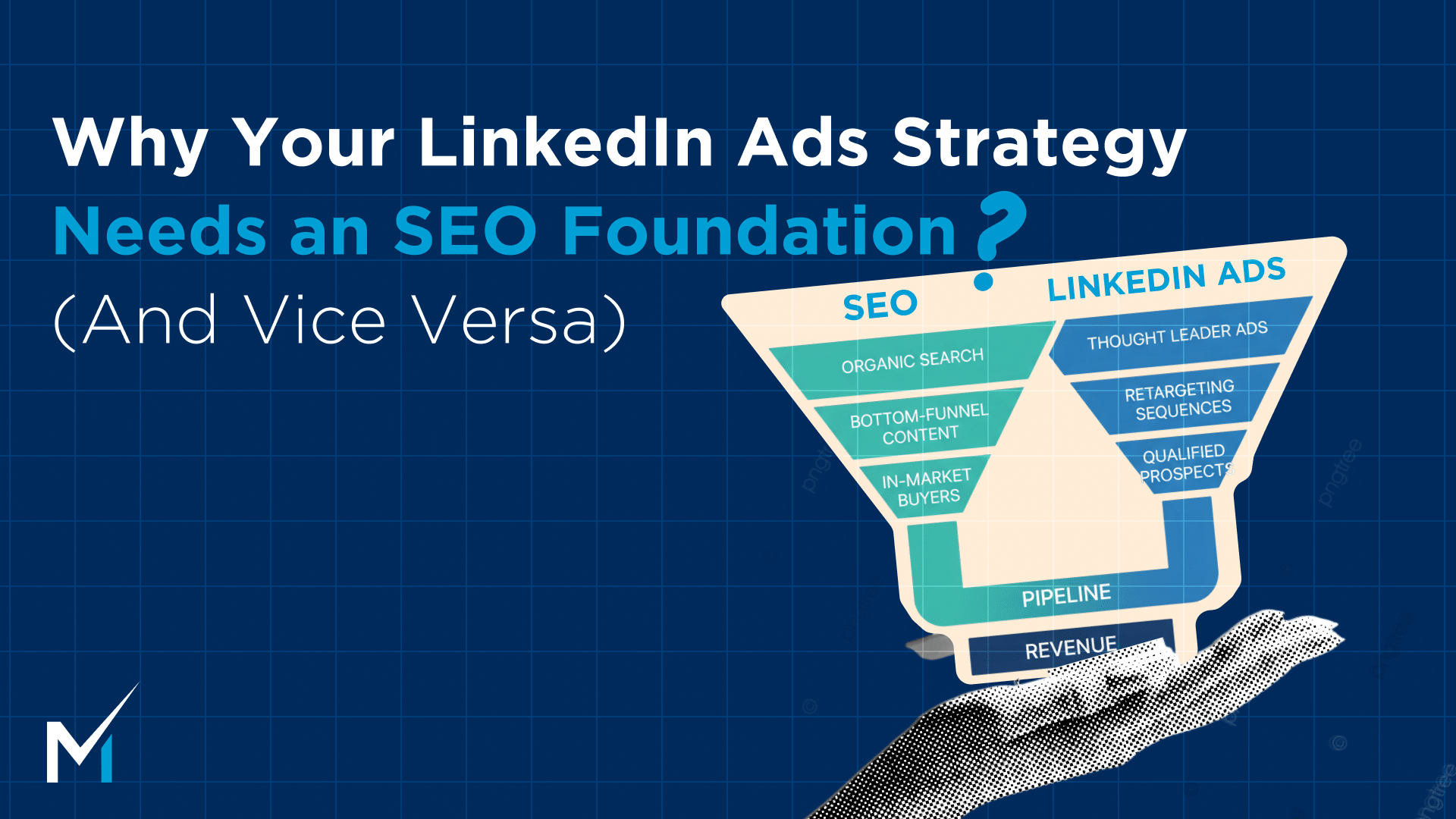
What Sam talks about at Breaking B2B, and what we see reinforced every day managing LinkedIn ad campaigns across 200+ B2B clients, is that the highest-performing marketing programs have something in common: each channel feeds the others. Organic content creates the proof. LinkedIn ads amplify it. Retargeting closes the loop. And the whole thing compounds over time.
That’s not a complicated concept. But most teams are nowhere near executing it.
Vanity Metrics Are Quietly Destroying Your Funnel
Let’s start at the root of the problem: what most SEO programs are actually optimizing for.
Traffic. Rankings. Clicks. Impressions.
These are easy to report and genuinely useless for measuring whether your content is contributing to revenue. Sam’s framework — which he calls “SEO for revenue, not vanity” — is built entirely around flipping this. Instead of monthly organic traffic reports, you’re measuring bottom-funnel leads generated and pipeline value attributed to content.
The shift sounds simple. The implications are massive.
When you stop chasing top-of-funnel traffic and start building content specifically for in-market buyers — comparison pages, competitor analyses, integration guides, solution-specific listicles — the same effort produces dramatically more pipeline. You’re no longer attracting researchers who are eight months away from a decision. You’re showing up for people actively evaluating options right now.
And here’s the part that matters for LinkedIn: that same bottom-funnel content becomes your best ad creative. The posts that resonate organically on LinkedIn — the ones that address real buying objections, show your track record, and answer the questions your prospects are Googling — those are the ones worth putting spend behind.
More on that in a minute.
What Bottom-Funnel Content Actually Looks Like
If you’re building an SEO strategy around revenue, the content types that move the needle are pretty specific.
Comparison pages. “[Your solution] vs [competitor]” pages capture people who are already in evaluation mode. They’re not browsing. They’re deciding. This is some of the highest-converting organic content you can produce.
Competitor analysis. Similar idea — people researching alternatives to tools they’re already using or evaluating. If your content shows up when they’re looking for reasons to consider something different, you’re entering the conversation at exactly the right moment.
Integration guides. “How [your solution] works with [tool they already use]” — this hits people with specific, adjacent intent. They’re not searching for you by name, but they’re searching for something closely related to what you solve.
Listicles and solution pages. “Best tools for [use case]” and industry-specific landing pages. These are the bread and butter of foundational SEO and, as Sam pointed out, they’re also the content types that consistently get pulled into LLM responses — so they’re doing double duty in the current search landscape.
The through-line across all of these: they’re built around buyer intent, not brand awareness. Someone reading a comparison page isn’t discovering a problem — they’re working toward a solution. Your content should meet them there.
How LinkedIn Thought Leader Ads Fit Into This
Here’s where the paid side comes in, and honestly, this is the part that most LinkedIn advertisers are sleeping on.
Sam’s approach to LinkedIn thought leader ads is refreshingly straightforward: find what’s already working organically, then amplify it. Don’t build a separate paid content machine. Don’t create new messaging from scratch for ads. Just take your top-performing posts — the ones that already proved they resonate — and put spend behind them to reach your ICP at scale.
This works for a few reasons.
First, thought leader ads don’t look like ads. They appear in the feed as posts from a real person, which means they get engagement and trust at a rate that brand-sponsored content can’t match. When someone sees a post from an actual founder or expert rather than a company page, they engage differently. The social proof carries over.
Second, you’ve already validated the content. If a post drove organic engagement, it means your audience found it compelling without any paid boost. When you amplify it, you’re not guessing — you’re scaling what already works.
Third, this approach creates consistency across your ecosystem. The content your ICP sees in organic search, the content they encounter on LinkedIn, and the ads they see in the feed are all saying the same thing because they’re coming from the same source. That continuity builds recognition and trust over time in a way that disconnected channel strategies never can.
We’ve seen this play out across client accounts consistently. Our LinkedIn ads funnel benchmarks show that thought leader ads maintain performance longer than standard formats — often months — because they feel like organic content rather than traditional advertising. Frequency caps matter less. Creative fatigue sets in slower. The flywheel keeps spinning.
Want to go deeper on the strategic side of this format? Check out our complete thought leader ads strategy guide.
The Cross-Channel Layer: Where the Real Leverage Lives
Once you have content working and thought leader ads amplifying it, the next step is extending that motion across channels. This is where a lot of B2B marketers either stop short or overcomplicate things.
The core insight is simple: not everyone you want to reach is active on LinkedIn. Some portion of your ICP is more reachable through Meta. Another pocket is consuming content on publisher sites through programmatic. Some are watching CTV. If you’re only running LinkedIn ads, you’re capping your reach at a subset of your actual addressable audience.
The smarter play — and what we walk through in detail in our ABM cross-channel guide — is to take the targeting intelligence you’ve built on LinkedIn and extend it. You own the data on who your ICP is. You can use that to reach the same decision-makers on other platforms, creating an ecosystem where your message follows your prospect through their day.
Programmatic retargeting is a huge part of this. The prospect who reads your competitor comparison page, then sees your thought leader ad on LinkedIn, then encounters your brand as a native ad on a trusted industry site — they’re going to walk into a sales conversation very differently than someone who only saw one touchpoint. They feel like they already know you. That’s the goal.
The same logic applies to demand gen content strategy. You’re not just running ads — you’re building the kind of sustained presence that makes your brand the obvious answer when your prospect is finally ready to buy.
The Attribution Reality Check
Okay, let’s talk about attribution, because this is where a lot of conversations go off the rails.
B2B attribution is messy. It always has been, and the proliferation of AI search, dark social, and multi-touch journeys has made it messier. If you’re waiting for a clean attribution model before committing to an integrated strategy, you’re going to be waiting a while.
Sam’s approach here is one we’ve come to agree with strongly: triangulate from multiple data sources rather than demanding that one model tells you everything. That means using platform attribution as one signal, layering in self-reported data (just ask people during discovery calls where they first heard about you), and paying attention to correlation between content performance and pipeline movement even when you can’t draw a straight line.
We break this down further in our LinkedIn ads performance measurement guide, including the three-pronged attribution framework we use across client accounts.
The important thing is not to let attribution complexity become a reason to stay siloed. Imperfect data from an integrated approach beats perfect data from a channel that isn’t contributing to revenue.
Speed Over Perfection: The Execution Principle That Changes Everything
One more thing Sam said in the episode that’s worth sitting with.
The companies that win at this aren’t the ones with the most polished content. They’re the ones that ship fast, measure what works, and iterate. Large enterprises with fourteen layers of approval often lose to scrappy teams that can go from idea to published in a week — not because the enterprise content is worse, but because by the time it publishes, the window has passed.
This matters for how you approach the integrated SEO + LinkedIn ecosystem. You don’t need a perfect content architecture before you start amplifying organic posts with paid. You don’t need a fully built-out comparison page library before you launch a retargeting sequence. You need a working hypothesis, a willingness to test, and a feedback loop that tells you what’s resonating.
Start with what you have. Find the posts that are already getting organic traction. Put $2-5K behind them through thought leader ads and see what moves. Check which pages in your organic funnel are already driving bottom-funnel behavior, and build from there.
The ecosystem compounds. But it has to start somewhere.
The Integrated Approach in Practice
So what does this actually look like when you put it together?
You’re building content that answers the questions your ICP is actively searching — comparison pages, competitor analyses, integration guides, and foundational SEO assets that capture in-market buyers before they’ve even heard of you. That same content lives on LinkedIn as organic posts from your team’s experts. The top performers get amplified through thought leader ads to your ICP. The people who engage get retargeted across channels — LinkedIn, Meta, programmatic, wherever they spend time. And throughout all of it, you’re building first-party data and audience signals that make every subsequent campaign more efficient.
If you’re combining this with Google Ads, the LinkedIn + Google pairing creates an especially powerful loop: search captures high-intent demand, and LinkedIn nurtures the consideration phase for anyone who doesn’t convert immediately.
The ABM demand gen playbook ties all of this together on the account side — making sure the ecosystem isn’t just reaching random audiences but is concentrated on the specific accounts you’ve identified as your best opportunities.
This isn’t a complicated framework. But it does require treating your channels as interconnected rather than independent. That’s the shift. And once you make it, the ROI from every individual channel — SEO, LinkedIn ads, programmatic — goes up, because each one is reinforcing the work the others are doing.
Ready to Build This for Your Business?
If you’re running LinkedIn ads and want to understand how they fit into a broader integrated strategy — or if you’re curious how your current SEO efforts could be working harder for your paid campaigns — we’d love to talk.
Our team at Impactable has helped 200+ B2B companies build the kind of marketing ecosystem where each channel makes the others stronger. Let’s start the conversation.
And if you want to hear the full breakdown from Sam Dunning directly, tune into the episode on Apple Podcasts, Spotify, or YouTube.