When you’re running LinkedIn ads, there are a few metrics you start hearing everywhere. CPL this, CPC that. “Lower cost per click is always better.” That’s the advice, and on the surface it makes sense.
But what about the context?
A $3 click that leads to an $800 CPL isn’t a win. A $10 click from someone on your pricing page who books a demo in 48 hours is. CPC without context is just a number. It doesn’t tell you if you’re reaching the right people, or if those people are anywhere close to buying.
We’ve looked at enough LinkedIn accounts to spot the pattern: most advertisers don’t have a CPC problem. They have a targeting problem. They’re paying for clicks from people who were never going to convert in the first place.
So instead of asking “what’s a good CPC,” ask this: what kind of CPC leads to pipeline?
That’s where the benchmark data gets interesting.
The 2025 Benchmark: What B2B Advertisers Actually Pay
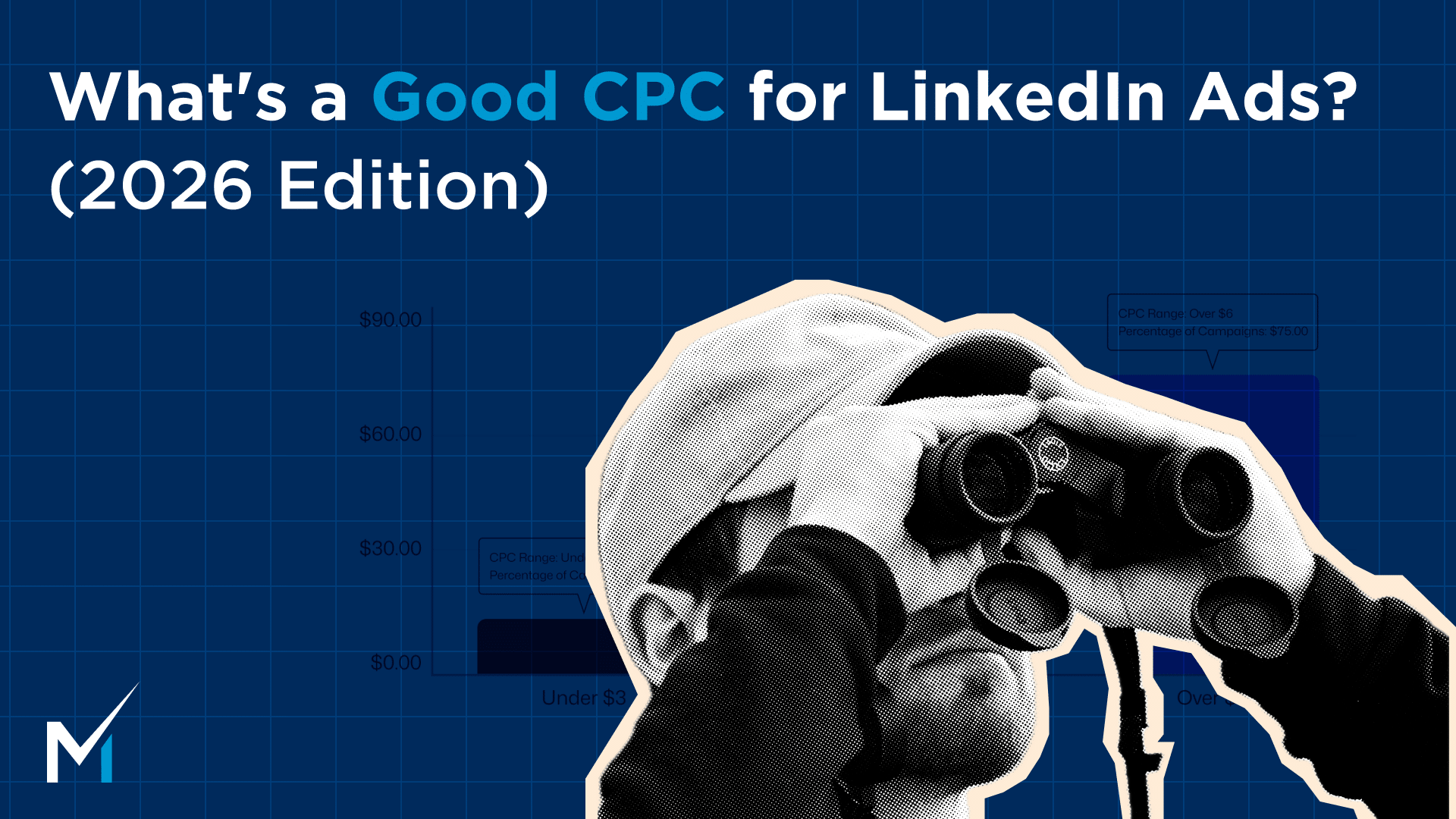
Let’s ground this in real numbers. The 2025 LinkedIn B2B Benchmark Report shows the average CPC is $5.59. That’s the middle of the curve, but the spread is where things matter.
75% of campaigns pay more than $6 per click. Only 12.5% manage to get under $3.
The difference isn’t because some advertisers are “better.” It’s because the inputs behind the clicks are completely different:
- Audience size and warmth
- Ad format and objective
- Signal density inside the targeting
- Message-to-intent alignment
Broad cold audiences always pay more. Retargeting with strong signals tends to collapse CPC over time. Senior decision-makers live in the higher range. Different ad formats like video and conversation ads behave differently than static images.
CPC hits $7, $8, $12 and most advertisers panic.
But you’re not buying clicks. You’re buying access to specific people. High CPC only becomes a problem when those people don’t actually matter. When it’s the right traffic, the cost question becomes irrelevant.
Cheap CPCs Don’t Mean Better Performance
Here’s what nobody wants to hear: a cheap CPC isn’t proof your ads are working. Most of the time, it’s the opposite.
Cheap clicks usually mean your targeting is wide open, and LinkedIn is dumping your ads wherever it can find the lowest competition. If you’re hitting a $2-$3 CPC, you’re often paying for curiosity clicks, a.k.a., people who will click anything interesting, then disappear.
That traffic looks great in a dashboard and does nothing for your pipeline.
What actually lowers CPC over time is intent density. The tighter your signals, the warmer your audience, and the more relevant your message, the more LinkedIn pushes your ads into people who already care. That’s when CPC starts to fall naturally.
This is where signal-based targeting pays off. When your audiences are built around actual buying signals like pricing page visits, return sessions, deep content interaction, effective CPC drops because you’re reaching people who already care. Tools like DemandSense sync those high-intent segments back into LinkedIn. You’re not paying for random eyeballs. You’re paying for people already evaluating solutions.
Cheap clicks don’t move pipeline. Relevant clicks do.
The Metric That Actually Matters: CPL and Lead Quality
CPC is loud, but CPL tells the truth. If your clicks are cheap and your CPL is sky-high, you’re not running efficient campaigns. You’re running traffic for the sake of traffic.
The benchmark data make this brutal:
- Native LinkedIn forms: $810.83 CPL
- External conversions: $221.14 CPL
Same platform. Same users. Completely different intent profiles.
Marketers brag about $2 clicks that turn into $800 leads. That’s not a win. That’s a slow leak.
External conversions look more expensive at first glance because fewer people complete them. But the people who do convert are deeper in the buying cycle. They left LinkedIn, hit your site, and made a conscious decision to fill out a form. That’s intent.
When you build audiences around real buying signals instead of demographic guesses, wasted clicks evaporate. Less waste means lower CPL, and lower CPL with stronger intent means higher SQL rates.
When High CPC Is a Warning Sign
High CPC isn’t always a red flag, but when it is, it usually points to specific problems:
- Audience overlap. Running multiple campaigns hitting the same people with similar offers means you’re bidding against yourself. LinkedIn loves it because it drives your CPC up without giving you anything meaningful.
- Audience fatigue. When warm segments see the same creative too long, CTR drops. Once CTR drops, CPC rises. That’s how LinkedIn’s relevance score works. The platform keeps showing your ads, but makes you pay for ignoring creative refresh cycles.
- Too broad or too cold. If your audience has no intent and no recent engagement, your ads feel irrelevant. Low relevance forces LinkedIn to spend more to find someone who might interact, so click prices climb even with massive audience sizes.
- MOFU campaigns competing against cold awareness. Pushing demo offers into large cold audiences inflates CPC fast because the demand isn’t there yet. It’s not a creative problem. It’s an audience stage problem.
High CPC can be a warning. But the warning isn’t “your ads are bad.” It’s “your audience strategy needs fixing.”
When High CPC Is Completely Normal (And Good)
A high CPC can be a sign your targeting is doing exactly what it should. Not every click should be cheap.
- Senior decision-makers always cost more. The C-suite doesn’t live in the $3 click bucket. Paying $8-$12 for that click is normal. Sometimes it’s the smartest spend in the account.
- Small high-intent audiences behave the same way. When you narrow down to people who hit your pricing page, returned to your site twice this week, or engaged with multiple touchpoints, you’re fishing in a smaller pond. CPC climbs because supply drops, but click value skyrockets.
- Demo offers push CPC higher. You’re asking for real commitment, not passive interest. The people who click are closer to evaluation. That traffic is worth more.
- Competitive industries. SaaS, IT, cybersecurity, dev tools—these markets have every brand outbidding everyone else for the same tiny group of evaluators. Cheap CPC is unrealistic. Healthy CPC is part of the landscape.
You’re not paying for a click. You’re paying for access to someone deep in a six-figure buying cycle. When the right people are clicking, a “high” CPC is one of the cheapest parts of the deal.
CTR Drives CPC More Than Your Bid Does
Most advertisers fiddle with bids when CPC climbs, but bids aren’t the real driver. CTR is.
The benchmark data spells this out: LinkedIn’s platform average CTR sits at 0.52%, while advertisers using intent-based platforms like DemandSense hit 0.875% on average. That gap isn’t luck. It’s relevance.
When the message matches the intent of the audience, CTR climbs. When CTR climbs, LinkedIn pushes your ads into cheaper inventory because the algorithm sees them as high-performing.
Two advertisers can target similar audiences and pay totally different CPCs. One has a message that hits. The other sounds like a brochure. One gets cheaper distribution. The other gets buried in expensive impressions nobody engages with.
Thought leader ads consistently outperform traditional sponsored content on CTR because they feel organic, not promotional. Before you tweak bids or budgets, look at the creative and message match. Low CTR is usually the first sign that something’s off. Fix the relevance, and CPC drops on its own.
So, What’s a ‘Good’ CPC in 2025?
A “good” CPC isn’t a single number. It’s a range that depends on who you’re targeting, what you’re offering, and where they are in the buying cycle.
- Under $3: Only 12.5% of campaigns land here, almost always at the top of the funnel. This is broad creative, wide audiences, and curiosity-driven clicks. Great for volume and early awareness. Not a guarantee of quality.
- $3-$6: The normal range for most well-structured B2B campaigns. When your creative matches your offer and your audience is defined but not overly narrow, you’ll land here. If CTR is solid and the message aligns with what people want, this range is healthy and repeatable.
- $6-$12+: This is where most senior decision-makers live. If you’re targeting executives, buyers with budget authority, or warm accounts showing interest, expect CPC to rise. There’s nothing wrong with this. As long as CPL and SQL rates justify it, this is often the highest-value traffic you can buy.
Cheap traffic isn’t the goal. Profitable traffic is.
Want Better CPC? Fix Your Audience Strategy
If you want a real lever for improving CPC, stop touching bids and start fixing your audience strategy.
The campaigns that consistently win are built on intent, not job titles. When you build audiences around behaviors—pricing page visits, repeat site sessions, deep content engagement—CPC drops because LinkedIn sees real relevance.
- Account-level retargeting takes this further. When multiple people from the same company start researching your solution, that account is heating up. The entire buying group becomes your audience targeting strategy, and it’s one of the easiest ways to improve efficiency because signal density is high and audience size is tight.
- Closed-loop attribution closes the gap. Once you can connect ad exposure to SQLs, pipeline, and revenue, you stop chasing clicks and start optimizing for outcomes. CPC looks totally different when you realize a $10 click from a high-intent account outperforms five cheap clicks from people who will never talk to sales.
- Identify anonymous visitors. Most B2B sites lose the majority of their visitors without capturing anything. High-intent traffic hits your site, bounces, and disappears. DemandSense identifies anonymous visitors and syncs high-intent segments back into LinkedIn. That turns missed opportunities into retargeting audiences that already know who you are.
If you want better CPC, don’t lower your bid. Raise the quality of the people you’re talking to.
A Good CPC Is One That Produces Pipeline
Most B2B campaigns land in the $5-$9 CPC range. That’s normal. The number only becomes meaningful when you look at what the click turns into.
CPC without lead quality is just noise. Signal-driven targeting is what drives real pipeline, not demographic filters or broad job title lists.
A high CPC with strong SQL performance is a healthy system.
A low CPC paired with weak CPL and poor lead quality is a leak, not a win.
The goal isn’t to pay less per click. The goal is to pay for the right clicks.
Want LinkedIn ads that actually produce pipeline, not just traffic? We’ve built audience strategies and signal-based targeting systems for hundreds of B2B companies. If your CPC, CPL, and SQL numbers aren’t lining up with revenue, let’s fix that together.