LinkedIn recently rolled out its ad personalization feature, and we jumped on it immediately – running extensive tests across three different accounts to see how it actually performs in real campaigns.
The results? More nuanced than we expected, and way more useful than just “it works” or “it doesn’t.”
TL;DR: Personalization isn’t a magic bullet. We saw CPA drop 47% in video campaigns and strong wins at the bottom of the funnel, but it actually hurt conversion rates for some cold-traffic website visits.
The key? Personalization excels at capturing attention (especially in video) but can lead to “shallow engagement” at the top of the funnel if you’re not careful. Read on for exactly when to use it and when to skip it.
If you’re considering using LinkedIn’s ad personalization (those dynamic macros like %FIRSTNAME%, %COMPANYNAME%, %JOBTITLE%), you need to know when it’s worth it and when it’s actually hurting your performance.
Let’s dig into what we found.
What Is LinkedIn Ad Personalization?
Quick context for those who haven’t played with this yet: LinkedIn’s ad personalization lets you dynamically insert profile information into your ad copy using macros. Think:
- %FIRSTNAME% → “John”
- %COMPANYNAME% → “Acme Corp”
- %JOBTITLE% → “VP of Marketing”
The idea is simple: personalized copy should feel more relevant, grab attention better, and drive stronger performance. Sounds great on paper, right?
Here’s what we needed to find out: Does it actually improve your key metrics, or is it just another feature that looks cool but doesn’t move the needle?
The Test Setup
We ran these tests across three different B2B companies to get a realistic read on how personalization performs in different scenarios:
- A healthcare cybersecurity company
- A CRM software provider
- A cash management solution for healthcare.
Different industries, different price points, different buyer personas.
For each account, we tested personalization at different funnel stages: some at top-of-funnel with cold audiences, others at mid or bottom-of-funnel with retargeting.
We ran:
- Website visit campaigns
- Video view campaigns
- Image-based sponsored content
Budgets ranged from a few hundred dollars to a few thousand per campaign variant.
The key thing: For every test, we ran the same campaign setup side-by-side. One version with generic copy, one with personalization macros. Same creative, same targeting, same budget allocation. The only variable? Those dynamic fields.
This gave us a clean comparison to see what personalization actually does to your metrics.
Our Findings
Here’s where it gets interesting. Personalization didn’t universally win or lose: it performed wildly differently depending on the campaign objective and funnel stage.
Best Performance: Video Campaigns at Top-of-Funnel
In one of our healthcare accounts, we ran video view campaigns with personalization at TOF. The results were strong across the board:
- CPM dropped 9%, meaning we reached more people for less money.
- CPC dropped 16%, so each engagement costs less.
- The effective cost per view (eCPV) dropped 8%, making video delivery more efficient.
Video completion rate jumped 61%: people actually watched instead of scrolling past. This is huge because it signals to LinkedIn that this is quality content, which improves delivery and efficiency.
But here’s what really mattered: Conversions increased 36% despite lower spend, and CPA dropped 47%.
Why did this work so well?
Our hypothesis: Personalization aligns perfectly with video content. When someone sees their company name or job title in the intro text, they’re more likely to stop scrolling and actually watch. That attention translates to higher completion rates, which signals to LinkedIn that this is quality content, which improves delivery and efficiency.
Example of what worked:
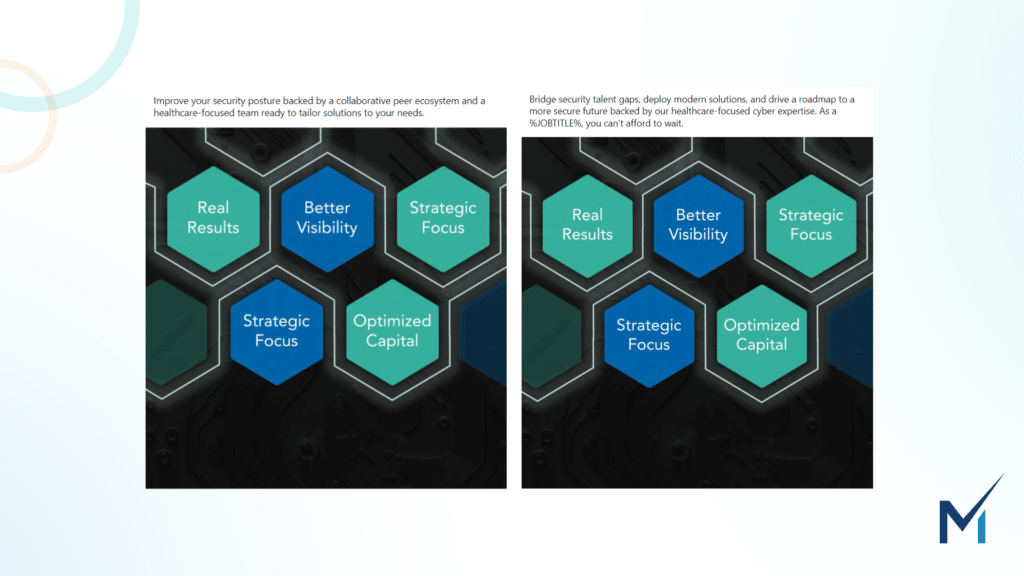
- Generic: “Bridge security talent gaps, deploy modern solutions, and drive a roadmap to a more secure future backed by our healthcare-focused cyber expertise.”
- Personalized: “Bridge security talent gaps, deploy modern solutions, and drive a roadmap to a more secure future backed by our healthcare-focused cyber expertise. As a %JOBTITLE%, you can’t afford to wait.”
A small addition, like acknowledging their role, made people lean in.
Strong Performance: Bottom-of-Funnel Retargeting
For one of our SaaS clients, we tested personalization on a bottom-of-funnel retargeting campaign (people who’d already visited the site). Results:
- CTR increased 49%
- Engagement rate jumped 40%
- 7 total conversions (2 call bookings + 5 form fills) vs. 0 in the control
- CPA of $325 vs. no conversions in the generic version
Yes, CPM and CPC were higher with personalization in this test, but here’s the thing: when you’re driving actual conversions at a reasonable CPA, the front-end cost efficiency matters less. The business outcome improved significantly.
Example of what worked:
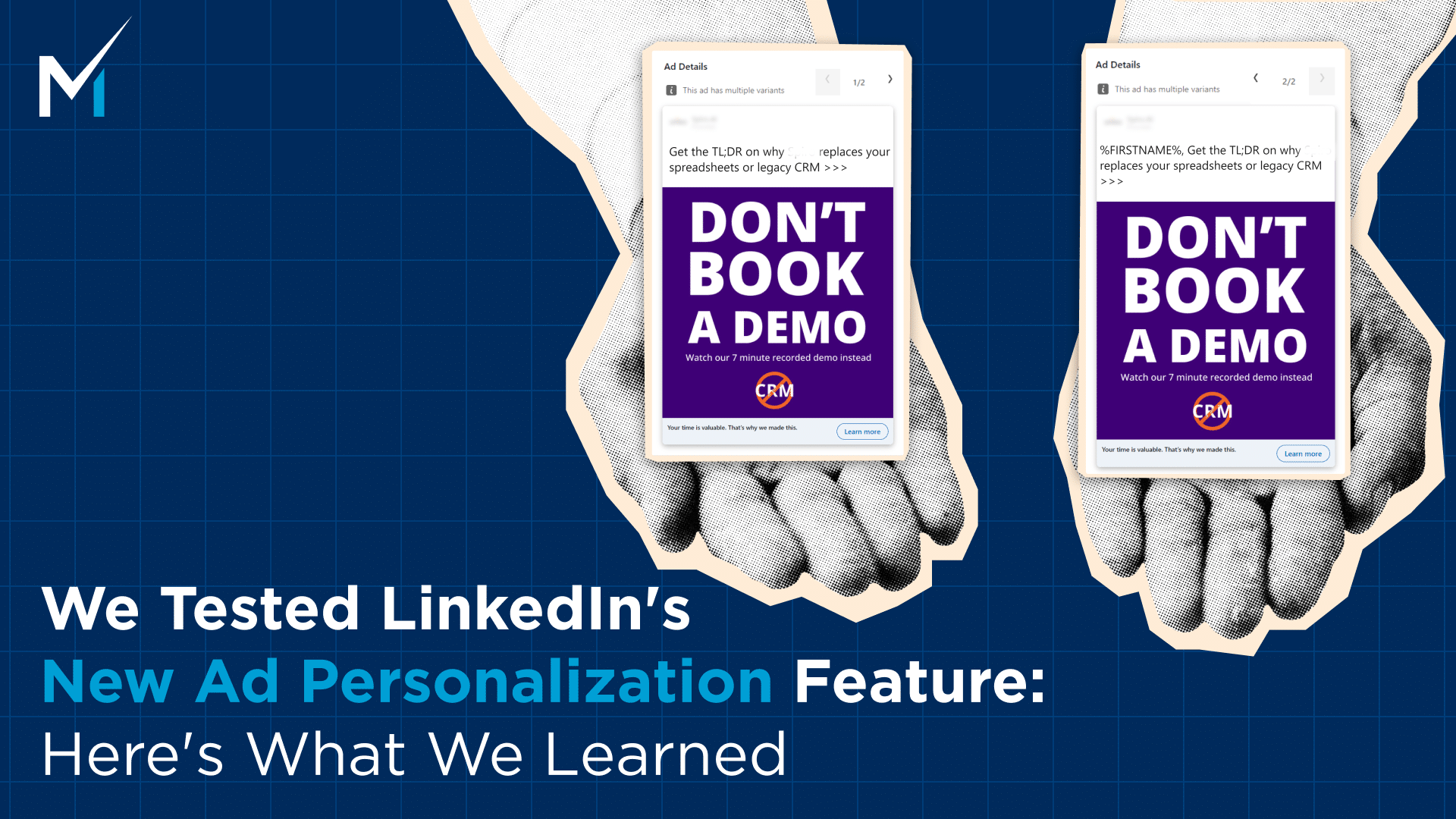
- Generic: “Get the TL;DR on why Acme replaces your spreadsheets or legacy CRM”
- Personalized: “%FIRSTNAME%, Get the TL;DR on why Acme replaces your spreadsheets or legacy CRM >>>”
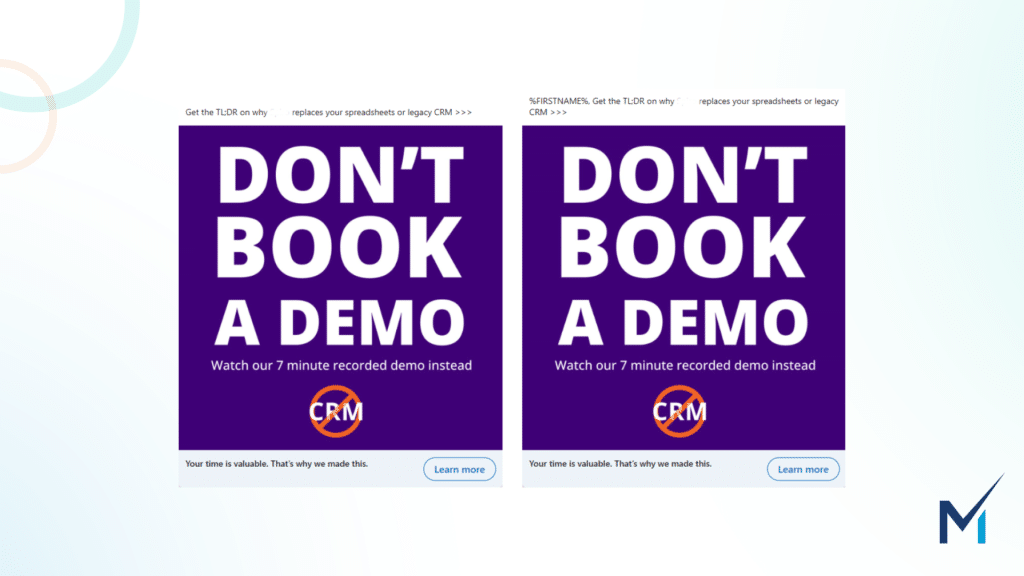
At BOF, these prospects already knew the brand. Adding their first name created a sense of direct communication that pushed them over the edge.
ROI Boost: Top-of-Funnel with Strong Creative
In another healthcare test at TOF, personalization improved the overall campaign economics even though CTR actually dropped slightly:
- CPM dropped 16% (better cost efficiency)
- Engagement rate increased 7%
- CPC stayed essentially flat (+1%)
- CPA dropped 42%
Even though we only got one extra conversion (from 1 to 2), the real win was in the efficiency metrics.
The slight CTR dip of 17% didn’t matter because we were reaching more people at better economics, ultimately driving a 42% reduction in CPA.
Where Personalization Underperformed
Website Visit Campaigns at Top-of-Funnel
Not every test was a winner. In one TOF website visit campaign, personalization actually hurt performance:
- CPM dropped 8%
- CPC dropped 6%
- Engagement rate jumped 40%
But:
- Conversions dropped 50%
- CPA increased 21%
What happened here? Our theory: Personalization can create “shallow engagement” at TOF.
The dynamic copy hooks people: they engage, they like, they comment. But they’re not necessarily more qualified. When they click through to the landing page, the personalized promise from the ad doesn’t always match the generic landing experience, so conversion rates drop.
Example that underperformed:
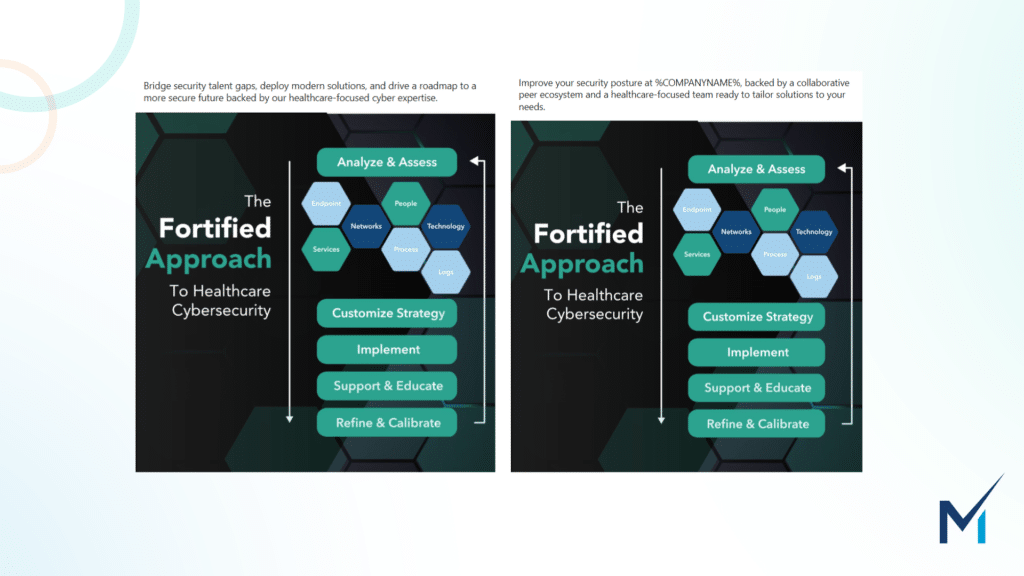
- Generic: Improve your security posture backed by a collaborative peer ecosystem and a healthcare-focused team ready to tailor solutions to your needs.
- Personalized: Improve your security posture at %COMPANYNAME%, backed by a collaborative peer ecosystem and a healthcare-focused team ready to tailor solutions to your needs.
Top-of-Funnel Personalization for Cold Audiences
In a CRM campaign at TOF, personalization drove incredible engagement but failed on business outcomes:
- CTR jumped 59%
- Engagement rate increased 235%
- CPC dropped 18%
- Dwell time increased 28%
But when it came to conversions? Zero, compared to 1 in the control campaign.
Our hypothesis: At TOF with cold audiences, personalization can attract attention without attracting intent. People see their company name or job title, they stop and engage, but they’re not necessarily ready to take action. It’s like getting a lot of likes on a social post, but no one is actually clicking your link.
The Shallow Engagement Trap: High engagement metrics (CTR, ER, dwell time) don’t always equal qualified interest. When personalization creates curiosity without intent at the top of the funnel, you end up with traffic that won’t convert. The fix? Either tighten your targeting, improve landing page continuity, or move personalization to mid/bottom-of-funnel where intent already exists.
5 Tips for Using Ad Personalization to Improve Your ROAS
Based on these tests, here’s what we’d recommend:
1. Start with Video + Personalization at Top-of-Funnel
If you’re going to test personalization anywhere first, make it video campaigns. We saw the strongest and most consistent results here. The combination of visual content + personalized copy creates a powerful attention-grabber.
How to implement:
- Use %JOBTITLE% or %COMPANYNAME% in your video ad intro text
- Keep the personalization natural – don’t just slap it on for the sake of it
- Make sure your video content actually aligns with the personalized message
- Watch your video completion rate and view-through rate – these should improve
What to measure:
- Video completion rate (VCR)
- eCPV (effective cost per view)
- Landing page clicks from video viewers
- CPA
2. Use Personalization for Bottom-of-Funnel and Retargeting
Personalization shines when people already know who you are. At BOF, adding someone’s first name or company name to a retargeting ad feels like a natural continuation of the conversation, not a cold interruption.
How to implement:
- Set up retargeting audiences (website visitors, video viewers, past engagers)
- Use %FIRSTNAME% for a more personal touch at BOF
- Reference their previous interaction subtly in the ad copy
- Make your CTA more direct – these folks don’t need as much nurturing
Be careful: If your landing page experience isn’t also personalized, be careful. The disconnect can hurt conversion rates. Either personalize the LP too, or keep your retargeting ads less aggressive with the personalization.
3. Test One Campaign at a Time
This is crucial: Don’t flip all your campaigns to personalization at once. We tested side-by-side, which let us see the real impact without tanking our overall performance.
How to implement:
- Pick one campaign to test – ideally a video campaign or BOF retargeting
- Run it alongside a control (same setup, no personalization)
- Give it 2-4 weeks to gather meaningful data
- Compare not just CTR and CPC, but actual conversions and CPA
- Only scale to more campaigns if you see real business improvement
4. Match Your Landing Page to Your Personalized Ad
One of the biggest lessons from our tests: When your ad is personalized but your landing page is generic, you create a disconnect that hurts conversions.
How to implement:
- If you’re using %COMPANYNAME% in ads, consider dynamic landing pages that also reference their company
- If you’re using %JOBTITLE% in ads, segment your landing pages by role
- At minimum, make sure your landing page headline reinforces the promise in your ad
- Use consistent language between ad and LP – if the ad says “for VPs,” the LP should too
Pro Tip: Tools like Unbounce or Mutiny can help you create dynamic landing pages that personalize content based on industry, company size, or job title. This creates continuity from ad to landing page without requiring custom development for every segment.
5. Watch Out for “Shallow Engagement” at Top-of-Funnel
This was our biggest surprise: Personalization can inflate engagement metrics without improving business outcomes. If your CTR and ER are up but conversions are down, personalization might be attracting the wrong kind of attention.
How to spot this:
- Engagement rate jumps significantly (30%+ increase)
- CTR improves or stays flat
- But… conversion rate drops
- And CPA increases
What to do about it:
- Tighten your targeting – you might be reaching too broad an audience
- Revisit your ad copy – is the personalized hook aligned with your actual offer?
- Test different personalization macros – %FIRSTNAME% vs %JOBTITLE% vs %COMPANYNAME%
- Consider moving personalization to mid or bottom-of-funnel instead
When to stick with generic messaging: If your TOF website visit campaigns are already converting well with generic copy, don’t fix what isn’t broken. Personalization isn’t a magic bullet – it’s a tool that works in specific contexts.
The Bottom Line
After running these extensive tests, here’s what we know for sure: LinkedIn ad personalization is not a universal win. It’s a powerful tool when used strategically, but it doesn’t so much for your performance if you apply it blindly.
Use personalization when:
- You’re running video campaigns at any funnel stage
- You’re retargeting warm audiences at mid or bottom-of-funnel
- You have the ability to match your landing page experience to your ad personalization
- You’re targeting diverse audiences where role or company specificity matters
Skip personalization when:
- Your cold TOF campaigns are already converting efficiently with generic copy
- You can’t create landing page continuity
- You’re seeing high engagement but low conversion rates in tests
- Your audience is too broad, and personalization creates irrelevant matches
The key insight from all our testing: Personalization works best when it enhances relevance for people who are already somewhat engaged. At TOF with cold audiences, it can create attention without intent. At BOF with warm audiences, it can be the nudge that converts.
Don’t just turn on personalization because it’s new and shiny. Test it strategically, measure the business outcomes (not just engagement metrics), and scale only when it actually improves your ROAS.
Want help testing ad personalization for your campaigns? We’ve run enough of these tests to know what works and what doesn’t. Let’s talk about how to approach this for your specific business.