Most B2B teams advertising on LinkedIn bet on cost per lead. And it makes sense: it’s the number everyone reports to leadership.
But there’s another metric buried in Campaign Manager that tells you way more about whether your funnel actually works, and almost nobody looks at it.
Form open rate.
We started tracking this metric closely when we built DemandSense and started digging into the actual conversion patterns across our client campaigns. What we found was pretty eye-opening.
Here’s what the 2025 LinkedIn B2B Benchmark Report shows: Out of everyone who clicks your ad, only 2.99% open the form. But once they do? 23.1% complete it.
Your form isn’t the bottleneck. The conversion rates on the form itself are solid.
But the real action happens in that gap between the click and the form open.
Once you start tracking this metric, everything else about LinkedIn performance starts making sense.
Where LinkedIn Conversions Actually Happen
Here’s the actual funnel when you break it down:
Click → Form Open (2.99%) → Submission (23.1% of opens)
Most advertisers look at their overall conversion rate and think the form is the issue. But when you split it out, you see something different. The form completion rate is actually strong—almost one in four people who open it follow through.
The gap is earlier. Between the click and the decision to engage with the form at all.
This is why two LinkedIn advertisers can run similar campaigns with wildly different results. One nails the landing experience and gets 5% form opens. The other has message drift and gets 1.5%. Both have the same form. Both see similar completion rates. But one is converting 3x better because they’re winning the battle that happens in the first few seconds after someone lands.
This is the leverage point. Not your form design. Not your button color. The moment between landing and deciding whether to engage.
What Drives Form Opens (The Variables That Actually Matter)
Form open rate comes down to a handful of variables. Get these right and you can double or triple your conversion rate without touching your form, your targeting, or your budget.
Message Continuity
The landing page needs to feel like a continuation of the ad, not a pivot. Whatever angle you used in the creative—that’s what should hit them in the headline.
If your ad says “Download the 2025 LinkedIn CPL Benchmarks,” your landing page headline shouldn’t shift to “Improve Your LinkedIn Marketing Strategy.” That drift costs you conversions in the first two seconds.
The best performers treat this like a rule:
Ad promise → landing page headline → value prop → CTA. All aligned.
All reinforcing the same thing. When the message stays consistent, form opens can jump 2-3x.
Value Clarity
Someone lands on your page and makes a decision in about three seconds. Are they getting what they came for, or do they need to scroll and hunt for it?
Most landing pages hide the actual offer. Clever headlines. Fluffy intro copy. Generic value props that could apply to anyone. By the time the visitor figures out what they’re actually getting, they’re already halfway to the back button.
The pages that convert spell it out immediately. “Here’s what you’re getting. Here’s why it matters. Here’s how to get it.” No interpretation required.
Proof
A few customer logos. A short testimonial from someone with an actual title. One or two stats that show you know what you’re doing.
These small credibility signals stack fast. Most B2B buyers approach every ad click with a bit of skepticism—they’ve been burned before by generic pages and weak offers. Proof shuts that skepticism down and makes opening the form feel safer.
Offer-Intent Match
This is the variable most advertisers miss. They run the same CTA to everyone and wonder why conversion rates are all over the place.
A cold audience doesn’t want a demo. A warm audience doesn’t want a basic awareness guide. A pricing-page visitor doesn’t want a top-of-funnel checklist.
- Cold audiences respond to low-commitment offers. Frameworks, benchmarks, cheat sheets.
- Warm audiences want depth. Case studies, comparison guides, and frameworks that help them evaluate options.
- Hot audiences want specifics. Demos, pricing, product walkthroughs.
This is where intent-based targeting makes a huge difference. If you can track who’s hitting your pricing page, who’s returning multiple times, who’s bouncing between comparison pages—those are buying signals you can actually target against.
Tools like DemandSense sync that on-site behavior straight back into LinkedIn, so you can serve demo offers to pricing-page visitors, mid-funnel content to warm audiences, and educational assets to cold traffic. Each group gets a CTA that matches where they are.
When the offer aligns with the journey stage, opening the form stops feeling like a leap. It just feels like the obvious next step.
What Matters When Someone Opens the Form?
Once someone opens your form, the completion rate sits at 23.1%. That’s almost one in four. For B2B, that’s a healthy number.
This tells you something important: the form itself isn’t your bottleneck. The friction happens earlier, in the gap between the click and the form open. Which means you should stop obsessing over field counts and button colors and focus on getting more people to the form in the first place.
That said, here’s what keeps completion rates strong once people do engage:
- Field count matters, but probably less than you think. Keep it to the essentials—name, business email, company, title. Anything beyond that belongs in a sales call. But shaving a form from 6 fields to 4 isn’t going to save your conversion rate if only 2% of people are opening it in the first place.
- Questions should match the offer. If you’re gating a benchmark report, don’t hit someone with budget qualification questions. If you’re offering a demo, the bar for relevance shifts. Match the form to the ask.
- Deliver what you promised. If the button says “Get the Report,” the next screen better give them the report. Any bait-and-switch here kills trust and tanks your follow-through rate.
- Privacy clarity helps. A quick note like “We’ll only email you the asset” removes hesitation. Small trust signal, real impact.
When these basics are in place, completion rates stay strong because the experience lines up with the expectation you set in the ad.
For more on tracking what happens after the form submit, check out our guide on improving conversion tracking for LinkedIn campaigns.
Native Forms vs. External Pages: How to Use Each
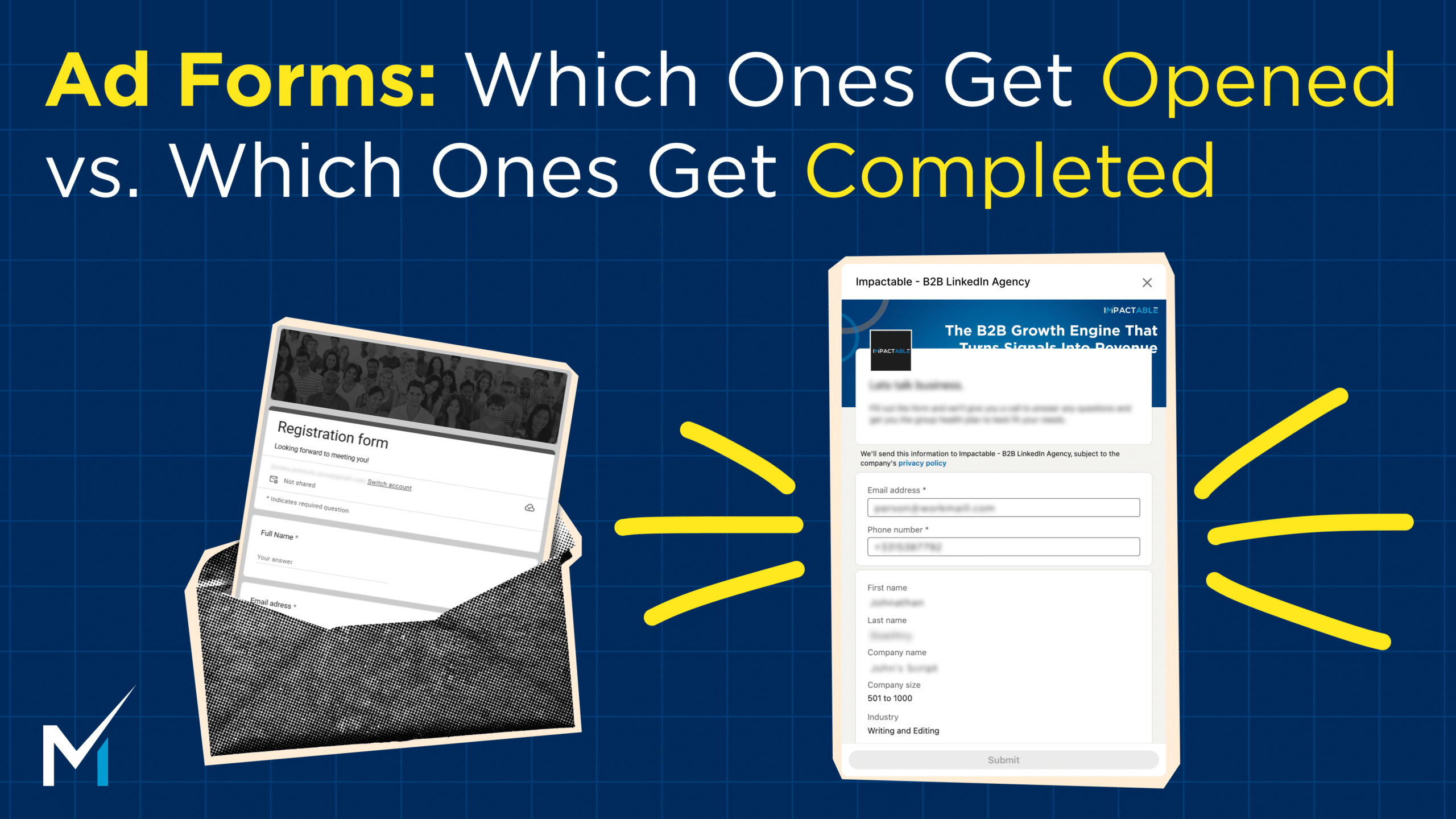
Native LinkedIn forms generate volume. The platform pre-fills most fields, friction is low, and you rack up submissions fast. For top-of-funnel campaigns where you’re building audience pools and gathering intel, that’s exactly what you want.
The trade-off? Lower intent. When converting is that easy, people do it without much thought. They’re not necessarily ready to talk, ready to buy, or even ready to read what you send them. But if your goal is reach and retargeting fuel, native forms do the job.
External landing pages flip the equation. Lower volume, higher intent. Someone who clicks your ad, loads your site, reads the page, opens the form, and fills it out isn’t just browsing. Every extra step filters out casual clickers and leaves you with people who actually care.
That’s why external forms consistently produce better pipeline quality, even if the raw lead count is lower. By the time someone submits, they’ve shown multiple micro-commitments. They’re more likely to engage with follow-up, show up to meetings, and move into real sales conversations.
Turn More Clicks Into Form Opens
Form open rate changes how you think about the entire funnel. Most advertisers tweak CPL without understanding where conversions actually break down. They adjust targeting, test creative, obsess over form fields—all while missing the fact that only 2.99% of their clicks ever engage with the conversion point.
The 23.1% completion rate tells you the form works. The 2.99% open rate tells you where the real opportunity sits.
Here’s what to focus on:
- Audit your message-match first. Pull up three of your active campaigns. Compare the ad promise to the landing page headline. If they don’t echo each other almost word-for-word, that’s your first fix.
- Check your click-to-form-open rate in Campaign Manager. Most advertisers have never looked at it. That one number will tell you more about your funnel health than cost per lead ever will.
- Map your offers to intent. Stop running the same CTA to everyone. Pricing-page visitors get demos. Return visitors get case studies. Cold traffic gets frameworks. Match the offer to where someone actually is.
- Build your retargeting structure. If you’re treating all website visitors the same, you’re leaving conversions on the table. Set up retargeting buckets based on recency and behavior—30 days for hot traffic, 90 days for warm, 180 days for reactivation.
When these variables align, form-open rates can double without affecting your budget, creative rotation, or form design. You’re just meeting people where they are and making the next step obvious.