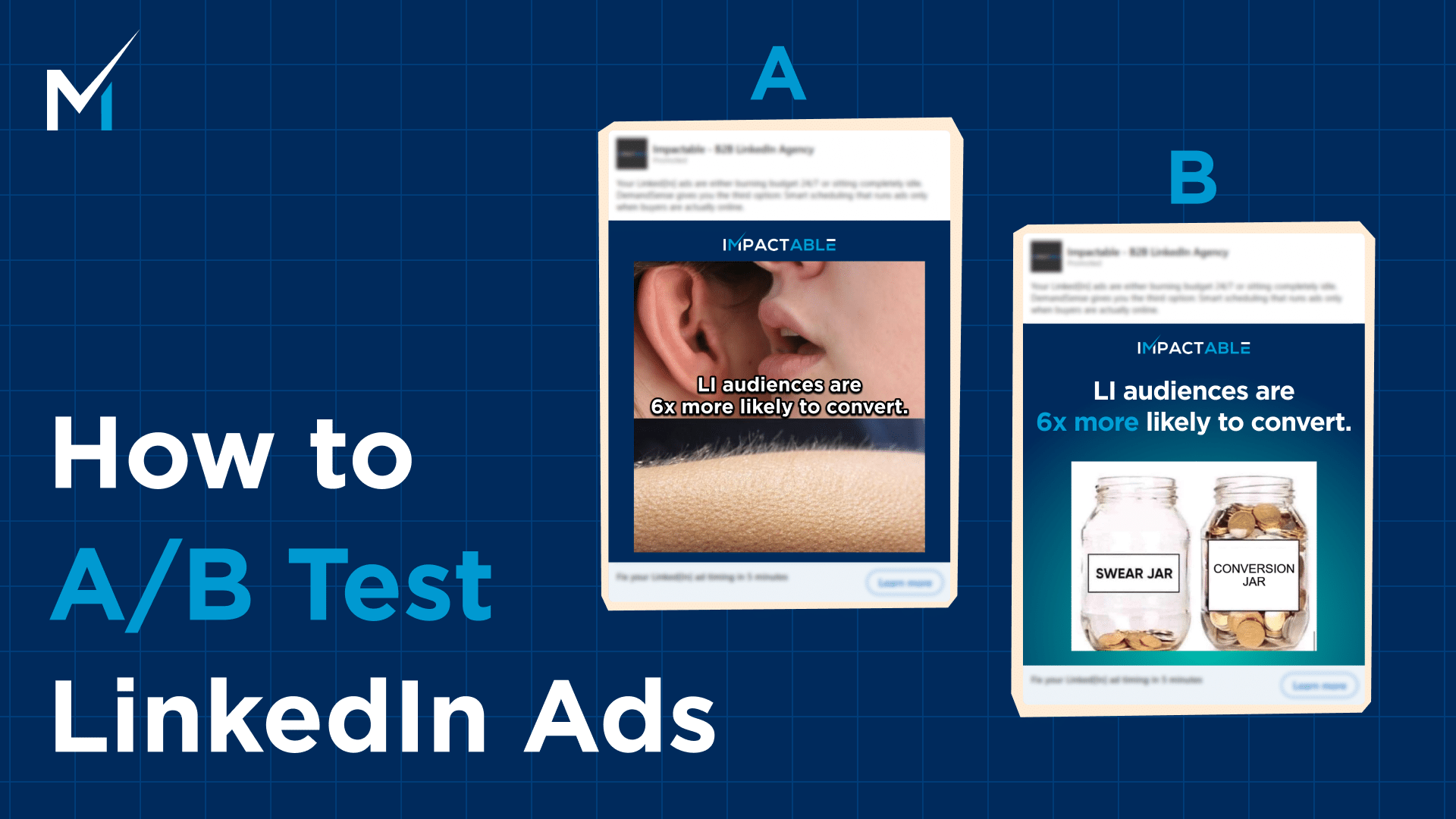
Most “A/B tests” on LinkedIn aren’t tests.
Teams change three things at once, run it for a few days, and crown a winner. That’s not testing. That’s guessing with better formatting.
Real testing means control, patience, and a clear read on what actually moved performance. You don’t need fancy stats or long reports. You just need a clean setup and the discipline to change one thing at a time.
Here’s the process we use to run LinkedIn A/B tests that actually teach you something.
What You Can Actually Test on LinkedIn Without Fooling Yourself
If you’re changing more than one thing, it’s not a test. It’s chaos with a budget.
Keep it clean: one variable per test. Same budget. Same schedule. Same optimization goal.
Here’s what’s actually worth testing:
- Creative: Image vs. image. Hook line. Thumbnail. Even the first ten words of your intro text.
- Offer: Free guide vs. calculator vs. webinar invite.
- Audience: Job titles vs. skills. Function vs. seniority.
- Format: Single image, carousel, video, or Thought Leader Ad.
Each test should answer a simple question: What change actually made performance move? If you can’t answer that, the test wasn’t structured right.
What not to do:
- Launch a new audience and new creative at once. You’ll never know what worked.
- Stop the test too early. Let the learning phase finish and collect enough data before calling a winner.
The Impactable Test Ladder
Run your tests in a smart order so you learn the most without wasting budget. Each step builds on the last so you can spot what really drives performance.
1. Hook First
Test the first 8–12 words. Try curiosity, benefit, or proof-based openings.
Keep everything else identical. This shows which angle actually grabs attention.
2. Visual Second
Once you have a solid hook, move to visuals.
Compare a scroll-stopping image against a product-in-context shot. Same hook, same offer.
3. Offer Third
Now test what you’re offering. A TOFU guide and a MOFU demo attract different levels of intent.
Keep your best hook and visual so you’re testing one thing at a time.
4. Audience Last
After the creative and offer are set, move to targeting.
Titles versus skills, narrow versus layered.
Keep your top-performing creative and offer as the baseline for every new test.
When you finish this ladder, you’ll have a clear baseline ad that deserves its budget spot. From there, keep running small, focused micro-tests to keep improving.
What to Test by Funnel Stage
Each funnel stage calls for a different type of test. The goal isn’t to find a universal winner but to see what works for each step of the buyer journey.
TOFU (Top of Funnel)
Goals: Reach, qualified clicks, video views.
What to test: Hook line, image type, format (video vs. carousel), short versus long intro text.
You’re trying to catch attention and build curiosity. Test creative that stops the scroll and messages that make people care enough to click.
MOFU (Middle of Funnel)
Goals: Lead form starts, content engagement quality.
What to test: Offer type, proof elements, CTA phrasing, and message match to the landing experience.
Here you’re earning trust. Test which angle convinces people to share their info or invest more time with your content.
BOFU (Bottom of Funnel)
Goals: Demo requests, SQLs, pipeline contribution.
What to test: Value prop framing, social proof level, urgency. Keep the creative clean and the message direct.
You’re not chasing clicks here. You’re testing what gets prospects to take the final step.
How to Set Up a Clean A/B on LinkedIn
A clean test setup is what separates data from noise. Here’s the right way to do it.
Step 1: Duplicate Your Baseline
Start with your best-performing campaign. Duplicate it so both versions are identical.
Step 2: Change One Variable
Only one thing changes. Hook, image, audience, or offer. Pick one.
If you change more than that, the results are useless.
Step 3: Keep Everything Else Identical
Same daily budget, bid type, schedule, and optimization event.
If one campaign gets a different auction or pacing, the data won’t line up.
Step 4: Let It Run
Give it at least a full week, ideally two, or until you hit a solid sample size.
Avoid checking every few hours. Let the system gather enough data to mean something.
Sampling Rule of Thumb
- Avoid calling a winner with fewer than 10,000 impressions per variant for creative tests.
- For lead goals, focus on form starts and completed leads instead of CTR.
Step 5: Judge by the Right Metric
Match the winning criteria to your goal:
- Traffic: Combine CPC and CTR.
- Lead Gen: CPL and form completion rate.
- Pipeline: Cost per SQL and sourced revenue.
Pitfalls to Avoid
- Audience overlap that exposes people to both versions.
- Uneven budgets or pacing that tilt results.
- Editing campaigns mid-test. If something breaks, restart from zero.
Ad Variations vs True A/B Testing
LinkedIn gives you two ways to compare performance, and both have their place.
Ad Variations
Ad variations inside a single campaign are perfect for quick creative testing.
They rotate your visuals and copy evenly or based on performance. It’s fast and useful for spotting top-performing creatives, but it’s not a controlled test.
True A/B Testing
A/B tests in Campaign Manager create two separate campaigns.
That isolation is what you need when testing audiences, offers, or formats. It keeps data cleaner and lets you trust the results.
When to Use Each
Use variations when you want quick creative optimization.
Use A/B testing when you want accurate learning you can apply to future campaigns.
Both have a role. One helps you move faster. The other helps you make smarter decisions.
EU Advertisers and the No-A/B Feature Reality
The A/B testing feature in Campaign Manager isn’t available for EU-targeted campaigns.
That doesn’t mean you can’t test. You just have to do it manually.
The Workaround That Still Works
- Set up one campaign with multiple ad variations.
- Use the “rotate evenly” option so each ad gets the same chance to perform.
- Keep every other setting identical.
- Let it run for at least 14 days or until you have a solid sample size.
- Choose the winner using the same goal-based metric you’d use for a normal A/B test.
When to Avoid This Setup
Skip this approach if your audience is too small or if frequency is high enough that the same people see all your ads.
That overlap makes results messy and hard to trust.
When done right, this manual setup gives you reliable learnings even without the official A/B testing tool.
Stats Hygiene Without the Math Lecture
You don’t need to be a data scientist to run proper tests. You just need discipline.
Keep It Real
Don’t call a test after two or three leads. That’s luck, not learning.
Wait until you have enough volume for the numbers to mean something.
Watch for Patterns, Not Spikes
Look for consistent direction over several days.
If performance jumps one day and drops the next, the test isn’t done.
Use Holdouts When You Can
Keep a small control audience or creative that doesn’t change.
It helps you see if results are from the new variable or from external noise.
Build on What Works
Save your winners as new baselines.
Only test one small change at a time from there.
That’s how you stack learnings instead of starting from zero each month.
The AI Loop That Actually Speeds Your Testing
AI tools don’t replace your testing process. They just help you move faster when you use them right.
Variant Ideation
Start by generating ten hook ideas based on your value proposition and customer pains.
It’s a quick way to see new angles without staring at a blank screen.
Headline Tightening
Take those hooks and trim them down to 40–60 characters.
Keep the promise clear and strong. No filler words.
Comment Mining
Pull comments from your top-performing posts or ads.
Look for phrases your audience repeats and turn those into new hooks or headlines.
Post-Test Readouts
Export your ad report once the test finishes.
Feed it into your AI tool, tell it your objective, and ask for patterns across winners and losers.
It’s an easy way to spot trends that would take hours to find manually.
Guardrails
AI gives you drafts. You make the final call.
Keep your voice consistent and every claim accurate.
QA Checklist Before You Hit Publish
Before you launch, check the basics. Small setup mistakes ruin good tests.
- Same budget, bid type, and schedule.
- Frequency caps aligned so one variant doesn’t overexpose.
- Conversions tracked and verified in Campaign Manager.
- Targeting saved as templates for repeat tests.
- Clear naming convention that includes the variable under test.
- Screenshots of every setup screen saved in your test doc.
A few minutes of QA saves you from two weeks of bad data.
What to Do After You Find a Winner
When the test ends, act fast. Winners are only useful if you apply what they teach.
- Promote the winner to evergreen and keep it running.
- Retire the loser so budget doesn’t drift into weak ads.
- Log the results in a simple doc with variable, goal, outcome, and what you’ll test next.
- Launch the next micro-test. Small, focused changes keep your learnings compounding over time.
Testing never stops. Each clean result becomes the starting point for your next improvement.
Final Thoughts
Most teams run tests to feel productive, not to learn. If your ads keep “winning” but your pipeline isn’t moving, the problem isn’t the testing process. It’s what you’re testing and how you’re calling the results.
If you want help building a real testing ladder and setting up a monthly creative sprint that actually improves pipeline, talk to us.