TL;DR: “Is LinkedIn worth it?” is the wrong question. The right one is whether the math works for your deal size, close rate, and budget, before you commit a dollar. This article gives you the exact model we run on every discovery call, three real business scenarios (green, red, borderline), and a straight verdict you can apply to your own numbers in 10 minutes.
I’ve sat in on enough discovery calls to know exactly how this conversation starts.
Someone gets on a call and within the first five minutes they ask some version of the same question: “Is this even worth it for a business like mine?”
Some of them have already tried LinkedIn ads elsewhere and got burned. CPL was $600. Nothing closed. They spent $10,000 and walked away convinced the platform is broken.
Others haven’t spent a dollar yet. They just don’t want to be the next story.
And here’s what I always tell them: LinkedIn ads didn’t fail those other companies. The math did. Someone launched without checking whether the economics of their specific business could ever produce a positive return at the CPL LinkedIn actually delivers. By the time they found out it couldn’t, they’d already burned through the budget.
The good news? That answer is knowable upfront. You don’t have to run a 90-day experiment to find out if LinkedIn can ever work for your business. You just have to look at the numbers first.
That’s what this article is about.
The Wrong Question vs. The Right One
“Are LinkedIn ads worth it?” sounds like a question with a simple yes or no answer. It’s not. It’s a math question disguised as a platform question.
The LinkedIn channel is neither good nor bad in isolation. Whether it works comes down to whether your deal value, close rate, and budget clear a specific economic threshold. Clear it, and LinkedIn ads can work well. Fall short of it, and no amount of creative testing or targeting optimization will save you.
Here’s the brutal truth: a $400 CPL on LinkedIn is completely normal for a cold B2B audience. Whether that’s a success or a catastrophe depends entirely on what a lead is worth to your business.
If your average deal is $3,000, a $400 CPL will never work. You’d need a 13% close rate to break even, and cold LinkedIn audiences don’t convert at 13%.
If your average deal is $40,000, a $400 CPL is almost embarrassingly cheap. Even at a 5% close rate, you’re generating $2,000 in revenue per lead on a $400 cost. That’s 5x return on every lead before you optimize anything.
Same CPL. Completely different outcome. The only variable is your business model.
So before we talk about whether LinkedIn ads are “worth it” in the abstract. Let’s figure out if they’re worth it for you.
The Model: Quick Filter First, Then Full Funnel
We run this in two parts on every discovery call. The first part takes two minutes and tells you whether LinkedIn is even worth modeling. The second part builds the full funnel, revenue goal in, required budget out.
Part 1: Three Quick Disqualifiers
If any of these fail, stop. The full model won’t save you.
Deal value under $10,000? LinkedIn’s B2B CPL floor starts at $285+. At $2,400 ACV, break-even CPL is $150. That means LinkedIn is structurally unprofitable before you run a single ad. The threshold isn’t arbitrary: it’s the point where CPL economics can produce a positive return. Below it, a different channel (Google Ads, direct outbound) almost always wins.
Sales cycle under 30 days? LinkedIn is a multi-touch, brand-building channel. If your deals close in two weeks, the awareness-to-pipeline model doesn’t fit. You’re paying CPM prices for a funnel that has no way to use them.
Break-even CPL below LinkedIn’s cold range? This is the one that gets people. The quick check:
Break-even CPL = ACV × Effective Lead-to-Close Rate
From our data across 200+ accounts and $100M+ in LinkedIn ad spend, cold audience CPL in the first 60–90 days looks like this:
| Industry | Cold CPL Range (First 90 Days) |
| B2B SaaS | $300–$600+ |
| Professional services | $250–$500 |
| Enterprise technology | $400–$700+ |
| Financial services | $200–$450 |
If your break-even CPL is below that range, you’re starting from a deficit. After 90 days of warm audience buildup (CRM retargeting, video viewers, site visitors), CPL typically drops to $75–$250. But you pay cold prices first, and the model has to work at that rate.
Clear all three? You’re ready for the full model.
Part 2: The Full Funnel Model
The full forecaster doesn’t take budget as an input. It calculates budget as an output. You start with a revenue goal, plug in your funnel rates and audience data, and the model tells you exactly what you’d need to spend each month to hit it. Here’s what it needs:
Your goal: How much new revenue do you want to generate from LinkedIn, and over what timeline?
Your funnel rates:
- Annual Contract Value (ACV)
- SQL to Close rate
- Lead to SQL rate
- Landing page conversion rate
- Click-through rate (CTR)
- CPM (what you’re paying per thousand impressions)
Your audience:
- Target companies (the accounts you’re going after)
- Personas per company (how many decision-makers per account)
- 30-day active rate (what percentage of that audience is active on LinkedIn)
The model runs the funnel in reverse, from revenue target down to required impressions, and returns a Required Monthly Budget. That number is your real answer: can this business afford what LinkedIn actually costs to hit its goal, and does the math produce positive ROAS?
The audience math behind the budget floor explains why these inputs matter more than the budget number itself.
The Calculation: Revenue Goal → Required Budget → Verdict
The quick version is the break-even CPL check:
Break-even CPL = Deal Value × Effective Lead-to-Close Rate
If your break-even CPL clears LinkedIn’s actual CPL range ($300–$600 cold), the basic math works. If it doesn’t, no creative or targeting fix will save you.
The full forecaster model goes further. Instead of estimating revenue from a given budget, it works backwards from your revenue goal, running a complete funnel from impressions through clicks, leads, SQLs, and closed deals, to calculate the monthly budget your target actually requires. The output answers the real question: is that budget number realistic for your business?
Here’s what it looks like across three B2B scenarios.
Three Business Scenarios: Green, Red, and Borderline
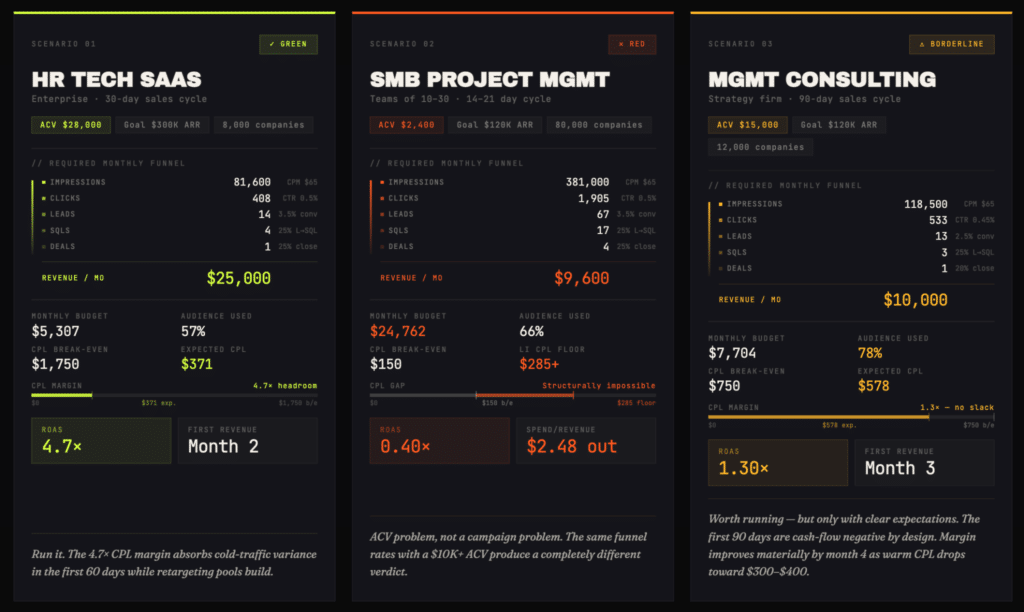
Scenario 1: Enterprise B2B SaaS (✅ Green)
HR tech SaaS · ACV $28,000 · Goal: $300K ARR · 8,000 target companies · 30-day sales cycle
Required monthly budget: $5,307 · ROAS: 4.7× · First revenue: M2
At $371 CPL against a $1,750 break-even, there’s 4.7× of margin before this campaign stops working. That’s enough headroom to absorb cold-traffic variance in the first 60 days while retargeting audiences build. The audience sits at 57% utilization, room to scale if the goal increases.
Verdict: Green. Run it.
Scenario 2: SMB Project Management SaaS (❌ Red)
B2B software for teams of 10–30 · ACV $2,400 · Goal: $120K ARR · 80,000 target companies · 14–21 day sales cycle
Required monthly budget: $24,762 · ROAS: 0.40× · Spend per $1 revenue: $2.48
The funnel rates here are identical to Scenario 1 (same SQL to Close, same Lead to SQL, same CTR). The only variable that changed is ACV. That’s the point. Break-even CPL at $2,400 ACV is $150. LinkedIn’s CPL floor starts at $285+. The margin structurally cannot exist, and no creative or targeting optimization changes that.
Verdict: Red. ACV problem, not a campaign problem. The same funnel rates with a $10K+ ACV produce a completely different verdict.
Scenario 3: Management Consulting (⚠️ Borderline)
Strategy firm · ACV $15,000 · Goal: $120K ARR · 12,000 target companies · 90-day sales cycle
Required monthly budget: $7,704 · ROAS: 1.30× · First revenue: M3
At $578 CPL against a $750 break-even, the margin is 1.3×. It works, but there’s no slack. Add a $3,000 management fee and total monthly spend hits $10,704 against $10,000 in revenue for the first 90 days. The math turns positive once warm audiences build and CPL drops toward $300–$400 by month 4.
Verdict: Borderline. Worth running, but only with clear expectations about the first quarter.
The 90-Day Reality Check: Your First Month Might Look Like It’s Not Working
Most net-new LinkedIn advertisers quit right here, before the channel has a chance to prove itself.
LinkedIn ROI follows a specific curve. The first 30 days almost always look bad. Not because the channel is failing, but because the signal-building process takes time and the warm audiences that drive your best CPL don’t exist yet.
| Timeframe | Typical ROAS | What’s Happening |
| 0–30 days | 0.3–0.8x | Cold only. No warm data. Every lead is expensive. |
| 31–90 days | 0.8–1.5x | Warm lists building. CPL starting to drop. |
| 90–180 days | 1.5–3.5x | Warm optimization in. Real benchmarks emerging. |
Dreamdata’s B2B marketing research puts LinkedIn’s median ROAS at 121%, compared to 67% for Google Search. Top performers hit 279%. But those are 180-day numbers. Nobody gets there at day 30.
The companies that “tried LinkedIn for 60 days and gave up” almost always quit right when the warm audiences were starting to build. That’s like pulling a football team off the field in the third quarter because they’re down a touchdown.
This timeline is also why we structure every new engagement as a minimum 90-day commitment. Not to lock you in, but because 60 days of data is the minimum to separate signal from noise. Before you launch, get clear on what LinkedIn attribution actually captures, and more importantly, what it doesn’t. Most new advertisers don’t, and they pull budget right when the data is still incomplete. For a full picture of what to expect across the first 90 days (CPL ranges, the ROAS curve, what gets validated at each stage), the new advertiser timeline covers it in depth.
What Does “Worth It” Actually Cost?
Let’s be straight about the full number, because the conversation around “LinkedIn ads minimum spend” often leaves out half the picture.
Ad spend minimum: $3,000–$5,000/month
At LinkedIn’s average CPM of $31–$34, a $3,000 monthly budget gets you roughly 90,000–95,000 impressions. Target a focused audience of 10,000–30,000 people and you’re hitting them at meaningful frequency, enough to actually build brand presence in their feed. Go below $3K and you’re scattered across too many people at too low a frequency to register. You’re not testing. You’re barely touching.
Management fees (if you’re working with an agency): ~$3,000/month
Working with Impactable on a fully managed LinkedIn ads program starts at $3,000/month in management fees on top of ad spend.
Total real commitment: $6,000–$8,000/month
That’s the honest number. Not meant to scare anyone off. Meant to make sure the revenue model you run above is against your actual all-in cost, not just the ad spend portion.
Minimum test runway: 90 days
Not arbitrary. The 30/60/90-day data curve genuinely requires that time to generate a real verdict on channel viability.
If this full picture runs through your revenue model and still shows green, you have a business LinkedIn ads can work for. If it shows red, better to know now.
The “LinkedIn Doesn’t Work” Pattern
Here’s what actually happened in most of those “$10K spent, zero return” LinkedIn horror stories.
A company starts without running the math. Their deal value is $6,000. Close rate is 7%. Expected CPL was never calculated. They just picked a $2,000/month budget because it felt safe. Break-even CPL: $420. Actual CPL: $380.
Wait, the math works? Almost. But they ran for 30 days, didn’t see pipeline close, and pulled the budget. The leads that did come in went into a CRM and sat in a 90-day sales cycle that hadn’t finished yet. Two months later, a deal closed from a LinkedIn lead they’d written off. They didn’t connect it back.
We hear this pattern constantly. The attribution problem is real, and it compounds for businesses with long sales cycles. LinkedIn’s influenced pipeline almost never shows up in last-click attribution, which means the ROI is invisible until you’re 6 months in and finally look at influenced deals.
Running the math first doesn’t just tell you whether to start. It sets the right expectations for what “working” looks like, and it keeps you from quitting before the data is actually there.
So, Are LinkedIn Ads Worth It for Your Business?
For the enterprise SaaS company with a $28,000 ACV: yes, clearly. For the SMB SaaS company with a $2,400 ACV: no, the deal size is below LinkedIn’s CPL floor regardless of how well the campaign runs. For the consulting firm with $15,000 projects: yes, but only with the right expectations about what month one is going to look like.
The model is the answer. And the model is just five numbers you already know about your business.
Once you’ve cleared the math, two more decisions before you launch. First, minimum budget. The floor exists for a specific reason and the number varies by business model. Second, format. Not all LinkedIn ad types perform equally on cold audiences, and picking the right one early matters more than people expect. Ad format selection breaks that down by use case.
If you want someone to run this model against your specific numbers (deal value, close rate, audience size, budget), book a discovery call. We do this on every first call. Takes 15 minutes, and you leave with a real go/no-go answer, not a sales pitch.
Every “LinkedIn doesn’t work” story starts the same way: someone skipped this step. Don’t skip it.