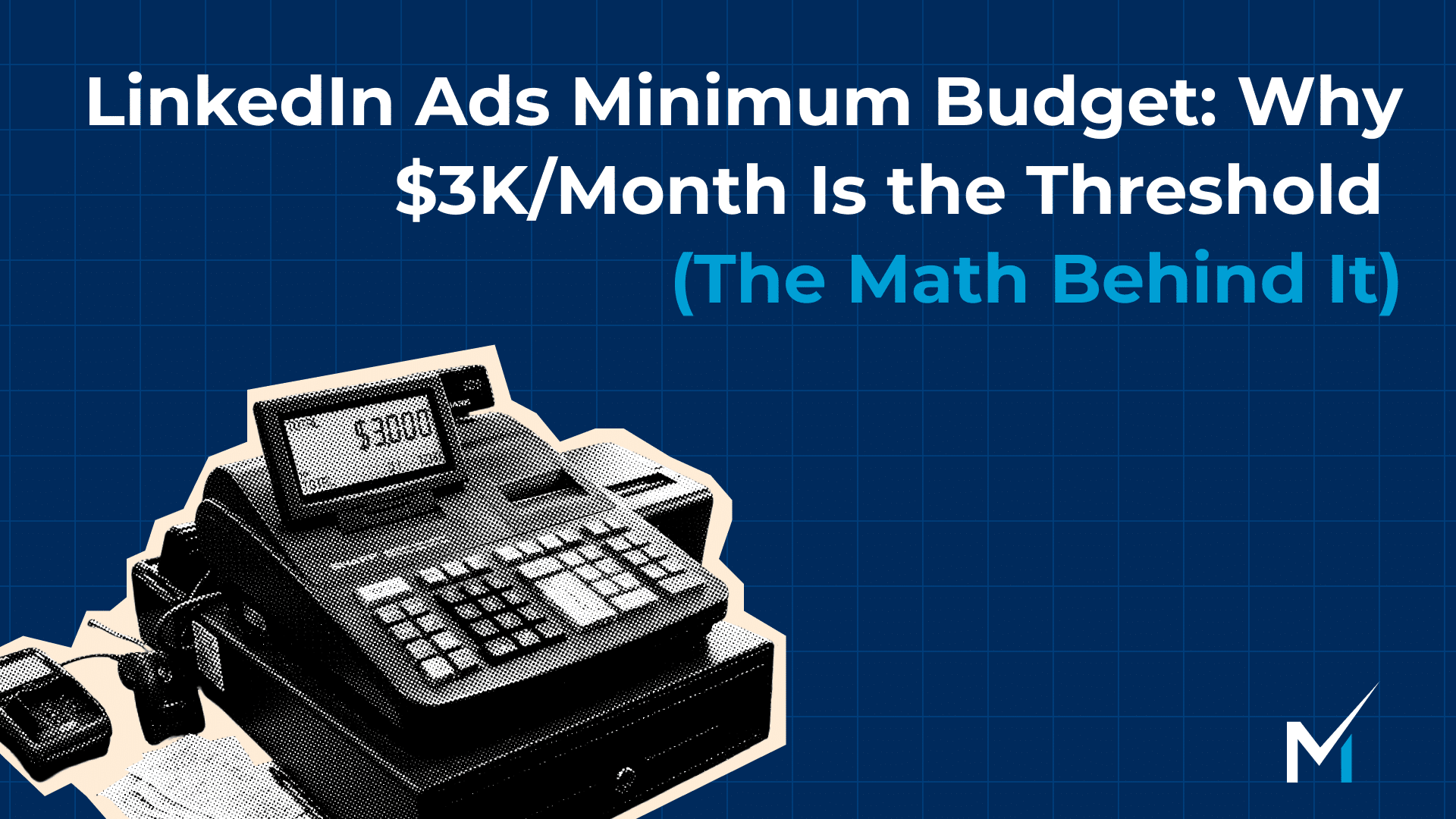
TL;DR: The $3K/month floor comes down to audience math, not a platform rule or an agency preference. Below that threshold, your frequency drops too low to register with buyers, your optimization data becomes noise, and you’re effectively paying to lurk rather than advertise. This article explains why, what happens at different budget levels, and how to find the right number for your specific business.
Somewhere on basically every first discovery call, we get to the budget question, and there’s a pause.
A prospect shares a number they had in mind, usually $500–$1,500/month, and one of our strategists says something like: “A $3,000 LinkedIn budget is tight. It’s the floor, and running below it means you’re not actually testing anything.”
That pause is the sound of someone recalibrating.
The $3K number surprises people. And the way most LinkedIn ads content handles it, just stating the number without explanation, doesn’t help. “You need at least $3K” sounds like an agency pushing for higher fees or a platform being exclusive about who gets to play.
It’s neither. It’s audience math. And once you understand the math, the number makes complete sense.
Why Budget Floors Aren’t Arbitrary: The Frequency Problem
Every dollar you spend on LinkedIn buys impressions. Impressions divided across your target audience determines how often each person actually sees your ad, your frequency.
Frequency is what advertising actually runs on. A buyer doesn’t see your ad once and convert. They see it, scroll past it, see it again, click through, leave, see a retargeting ad two weeks later, and eventually request a demo. That’s a normal B2B conversion path on LinkedIn. It requires multiple impressions across a meaningful span of time.
When your budget is too low relative to your audience size, one of two things breaks:
- Problem 1: Frequency too low : Your $1,500/month gets spread across 100,000 LinkedIn members who fit your targeting. Each person sees your ad roughly once. Once is invisible. Nobody registers a brand or offer from a single impression in a busy LinkedIn feed.
- Problem 2: Audience burns out fast : You respond by tightening your audience to 5,000 people to concentrate frequency. Now your $1,500 is hitting 5,000 people 10+ times a month. That sounds good until you realize LinkedIn fatigue kicks in around 6–8 exposures, your CPCs spike as the algorithm detects declining engagement, and you’ve spent your whole budget on the same tiny pool of people instead of building reach.
The right budget finds the middle ground: enough spend to hit a meaningful audience (10,000–30,000 people) at meaningful frequency (6–10 times per month) over a sustained period.
That’s what $3,000–$5,000/month actually buys.
What Different Budgets Actually Buy on LinkedIn
LinkedIn’s average CPM runs $31–$34 for B2B audiences. Enterprise and highly specific targeting (senior job titles at companies in specific revenue bands) runs higher ($45–$60 CPM isn’t unusual).
At the standard range, here’s what each budget level actually delivers:
| Monthly Ad Spend | Est. Monthly Impressions | Sustainable Audience Size (6–10x freq.) |
| $1,000 | ~30,000 | 3,000–5,000 people |
| $2,000 | ~60,000 | 6,000–10,000 people |
| $3,000 | ~90,000–95,000 | 10,000–15,000 people |
| $5,000 | ~150,000–160,000 | 15,000–25,000 people |
| $10,000 | ~300,000+ | 30,000–50,000 people |
Run $1,000/month and you’re either hitting 30,000 people once (invisible) or 3,000 people 10 times (audience exhausted inside 60 days). There’s no version where $1,000/month produces readable B2B results. You’ll get data (impressions, clicks, maybe a few leads), but the data won’t be telling you anything meaningful about whether LinkedIn can work for your business. It’ll be telling you what happened when you ran an underfunded test.
That’s not signal. That’s noise with a price tag.
What Happens When You Run LinkedIn Ads Below $3K/Month
This plays out the same way almost every time we see it.
A company allocates $1,500/month to “test” LinkedIn. They build a reasonable audience, 50,000 people matching their ICP, and launch a campaign. After 30 days, they’ve generated 2–3 leads. CPL is $500+. They look at their Google Ads account where they’re generating leads at $80 each, declare LinkedIn “too expensive,” and pull the budget.
Here’s what actually happened:
At $1,500/month against a 50,000-person audience, each person in that audience saw the ads roughly 0.6 times during the month. Less than once. The campaign never had a real chance to register with anyone. The 2–3 leads who did convert were probably already familiar with the brand from other channels. You paid $1,500 for what amounted to a light brand reminder to people already in your orbit.
That’s a frequency failure caused by underinvestment, not a LinkedIn failure.
The platform didn’t fail. The budget did.
We’ve seen this play out in attribution data, too. LinkedIn attribution already has enough gaps without adding underfunded campaigns into the mix. Companies regularly write off channels based on incomplete data from underinvested tests, when the problem was never the channel. The mistake is running LinkedIn ads at a scale that guarantees inconclusive data.
The Real Minimum: Ad Spend Plus Management
One more thing to be honest about before you run the math on your own numbers.
The $3,000/month floor everyone references is the ad spend minimum. If you’re working with an agency, that’s separate from management fees.
At Impactable, a fully managed LinkedIn ads program starts at $3,000/month in management fees on top of ad spend. That puts the real monthly minimum at:
| Component | Amount |
| LinkedIn ad spend (floor) | $3,000–$5,000 |
| Management fee (Impactable) | $3,000 |
| Total monthly commitment | $6,000–$8,000 |
That’s the honest number. Not trying to qualify people out. Trying to make sure you run your revenue math against the actual cost, not a partial one.
And speaking of that revenue math: the budget question only makes sense once you’ve answered the economics question first. Run the go/no-go revenue model first (deal value, close rate, expected CPL) and make sure the business case is there before you get into budget specifics. The budget conversation only matters if the model shows green.
The Minimum Test Timeline: Why 90 Days, Not 30
Budget floors apply to time as much as dollars.
Even with the right spend level, 30 days isn’t enough to draw meaningful conclusions from a LinkedIn campaign. Here’s why the minimum evaluation window is 90 days:
- Days 1–30: You’re building cold audiences. No warm retargeting exists yet. CPL will be at its highest, typically $300–$600+ depending on industry. Your ROAS will look negative. This is normal and expected.
- Days 31–60: Warm audiences start building: CRM lists activate, video viewers accumulate, site visitor retargeting kicks in. CPL starts to drop. You have enough impression data to start making informed creative optimizations.
- Days 61–90: The first real optimization cycle. Warm CPL drops toward $75–$250. You now have 60 days of data to separate signal from noise. The first 60-day impact report is deliverable. This is when you actually know something.
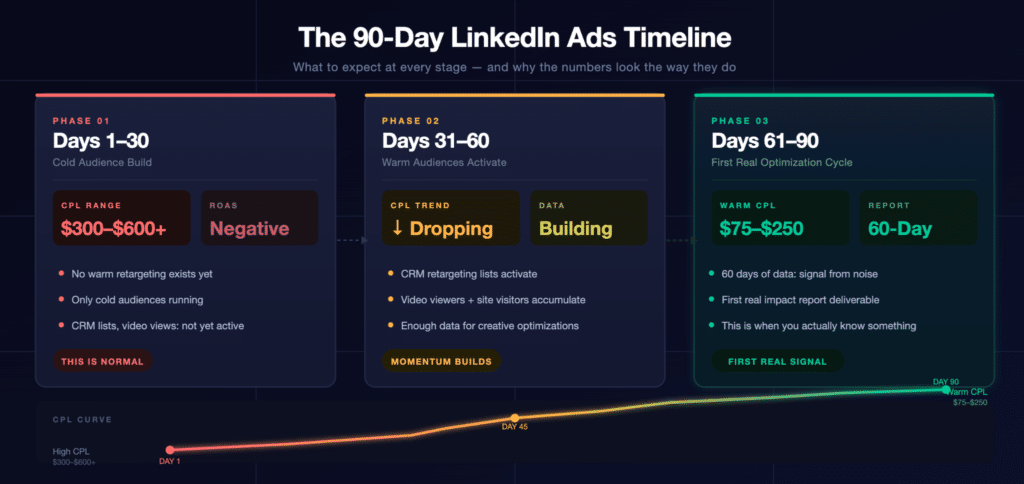
Companies that pull budget at day 30 because “the CPL is too high” are quitting right when the expensive cold-audience phase is ending and the efficient warm-audience phase is beginning. The hesitation is understandable, but it’s the leading cause of bad LinkedIn ads outcomes that get blamed on the channel instead of the timeline. The 30/90/180-day ROAS curve, what gets validated at each stage, and how to calibrate expectations with your team upfront are all covered in the new advertiser timeline.
But What If I Can’t Afford $3K/Month Right Now?
This is the most honest question someone can ask, and it deserves a straight answer.
If your budget is genuinely below $3,000/month in ad spend, LinkedIn isn’t the right channel to prioritize right now. That’s a realistic allocation decision, not a gate.
At $1,000–$2,000/month in ad spend, there are better options for generating B2B pipeline:
- LinkedIn Outreach (connection-based, not paid): zero ad spend, high intent, slower but possible at any budget
- Retargeting only : if you already have meaningful web traffic (5,000+ monthly visitors), you can run LinkedIn retargeting campaigns against a warm audience at lower spend. The pool is small but conversion rates are much higher.
- Meta B2B : lower CPMs than LinkedIn, and while the professional targeting isn’t as precise, some B2B segments convert well at $1,500–$2,000/month
None of those options produce the same results as a properly funded LinkedIn ads program. But “not yet” is a better answer than burning $1,500/month on LinkedIn results that won’t tell you anything useful.
If you’re building toward a real LinkedIn ads budget, the moves that matter most in the meantime are building your retargeting audiences organically (publishing content, driving traffic, growing your email list) so that when you do have the budget for a real campaign, you’re launching into a warm pool instead of starting cold.
Is Budget Enough? No. Deal Value Matters Just as Much.
One more thing the budget conversation tends to skip: having the right budget doesn’t guarantee LinkedIn ads work. Budget and deal value have to clear the threshold together.
A company with a $5,000 monthly ad budget and a $4,000 average deal size is in a worse position than a company with a $3,000 budget and a $30,000 average deal. The CPL math doesn’t work if the deal value isn’t there to absorb it, regardless of how much you spend.
The threshold we consistently see: deal value above $10,000. Below that, LinkedIn’s cost structure makes positive ROI extremely difficult to achieve on cold audiences. Above it, there’s room to work with.
Before you finalize any budget number, run the revenue model first. Five inputs, one verdict. Takes 10 minutes and tells you whether the economics of your specific business can support LinkedIn ads before you commit anything.
Budget Efficiency: Getting the Most Out of What You Have
Once you’re at or above the minimum threshold, there are real levers for making a given budget work harder.
- Audience segmentation over broad targeting : $3,000/month against a tightly defined 15,000-person ICP outperforms the same budget scattered across 150,000 loosely matched profiles every time. Narrow and deep beats wide and shallow, especially in the first 90 days.
- Ad scheduling : LinkedIn has no native dayparting. By default, ~80% of your budget burns overnight and on weekends when decision-makers aren’t on the platform. One agency cut LinkedIn ad costs by 56% just by adding scheduling through DemandSense. At any budget level, scheduling is one of the most impactful efficiency moves available.
- Lead Gen Forms over landing pages (at lower budgets) : LinkedIn’s native Lead Gen Forms convert at roughly 2x the rate of click-through campaigns to external landing pages. Lower budget = less room for friction. Remove the landing page step and your leads per dollar goes up.
- Warm-first sequencing : If you have any existing warm audience (email list, site visitors, event attendees), start there. Warm CPL is $75–$250 versus $300–$600+ for cold. Even a small warm pool stretched over the first 30 days lowers your overall CPL and gives you better data faster. The full playbook (which campaign settings waste spend and which ones don’t) is in running LinkedIn ads on a limited budget.
Find Your Number
$3,000/month is the floor, not because Impactable set it, not because LinkedIn requires it, but because audience math demands it.
Below $3K, your frequency is too low to register. Your data is too thin to optimize. And your verdict at the end of 30 days tells you nothing except that you didn’t spend enough to find out.
Above $3K, and combined with a deal value that clears the $10,000 threshold, there’s a real path to LinkedIn ads that generate pipeline, compound over time, and outperform most other B2B paid channels on a 180-day ROAS basis.
If you want to skip straight to figuring out whether the math works for your specific business, book a discovery call with Impactable. We run this budget and revenue model on every first call. You’ll leave with a clear number, not a ballpark, a real go/no-go, in 15 minutes. And if you’re still evaluating whether to bring in an agency, knowing the red flags to watch for matters. The wrong one will burn through your minimum budget before you ever see a real signal.