Competitive Whitespace Analysis: How We Break Down a Category's LinkedIn Ads to Find the Message Nobody Owns
How we break down a category's LinkedIn ads to find the message nobody owns — the 4-part method, with real findings from two category teardowns.
07/30/2026
TL;DR: Competitive whitespace analysis for LinkedIn ads is a structured read of every ad your competitors are running, mapped four ways: comparative overview, message saturation, positioning clusters, and whitespace. The output isn't a swipe file. It's a shortlist of claims your entire category has left unclaimed — which is where your ad budget should go.
Here's a question we ask on basically every discovery call: "Is there anyone advertising on LinkedIn that you're trying to surpass?"
And here's the answer we get, almost word for word, more often than any other:
"We have a list of brands we consider competitive in the US market — but I'm not aware of who's advertising."
Read that again. They know who. They don't know what.
We went back through a season's worth of discovery call summaries and pulled every mention of competitors — more than half of those calls raised competitive positioning unprompted. It's one of the most consistent themes in the entire sales conversation. And yet almost nobody in that group could tell us what their competitors' ads actually say. They've got a rival they want to beat and zero visibility into the message they're being compared against.
That gap is expensive. You're about to spend $5K, $20K, $50K a month telling the market something — and you have no idea whether six other companies are already telling them the exact same thing with a bigger budget.
Competitive whitespace analysis closes that gap. Here's the whole method.
What Is Competitive Whitespace Analysis for LinkedIn Ads?
Competitive whitespace analysis is a structured audit of every ad your competitors are currently running, organized to reveal which messages the category has saturated and which ones nobody has claimed. You end up with a map: here's what everyone says, here's what almost nobody says, here's the gap worth buying.
Three things it is:
- A messaging exercise, not a creative one. You're cataloging claims, offers, proof types, and positioning — not collecting pretty ads.
- Category-level, not competitor-level. One competitor's ad tells you nothing. Six competitors saying the same thing tells you everything.
- An input to media planning. The output feeds directly into what you write, which segments you write it for, and what you refuse to say.
One naming note before we go further. Search "white space analysis" and you'll get sales enablement content about cross-sell and upsell opportunities inside existing accounts. That's a completely different discipline — same words, different job. When we say whitespace, we mean messaging whitespace: the unclaimed positions in a category's advertising. Worth being precise about, because the two get conflated constantly in B2B strategy decks.
Why Can't Most B2B Marketers Describe Their Competitors' Ads?
Because competitor ads are the one competitive input nobody's job description covers. Product teams track feature parity. Sales tracks win/loss. Nobody owns "what is the category saying in paid social this quarter."
There's also a sophistication split we see clearly on calls:
- Martech-native buyers sometimes arrive with their own LinkedIn Ad Library pulls. They've looked. They just don't have a framework for what to do with what they saw.
- Traditional-industry buyers — manufacturing, logistics, professional services — usually have zero ad visibility. Many don't know the Ad Library exists.
Both groups have the same underlying problem: observation without methodology. Screenshots in a Slack channel are not a strategy. The value isn't in seeing the ads. It's in the pattern across them.
The 4-Part Method: How We Actually Run a Whitespace Analysis
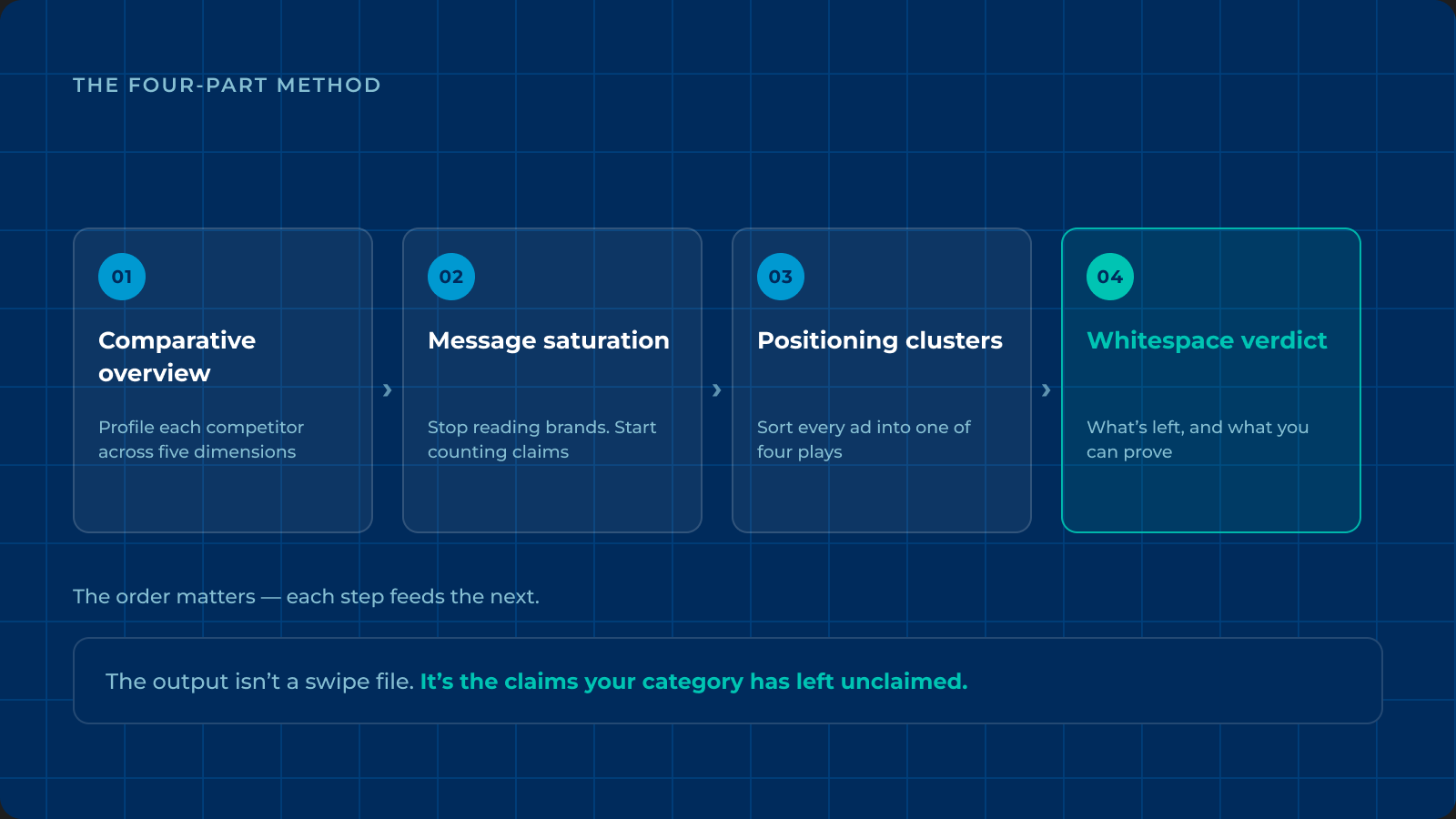
Every whitespace report we produce follows the same four-part structure, in this order. The order matters — each step feeds the next.
- Comparative overview — what each competitor is saying, one by one
- Message saturation — what they're all saying, collectively
- Positioning clusters — the strategic plays underneath the claims
- Whitespace takeaways — what's left, and what you should do with it
Step 1: Comparative Overview
Pull every live ad from every competitor you can find, then profile each brand across five dimensions:
Dimension | What you're capturing | Example from a real teardown |
|---|---|---|
Core value proposition | The one-sentence promise | "Keep the client. Capture the revenue. We'll handle delivery." |
Emotional tone | How it's said | Challenger, consultative, provocative, contrarian |
Proof mechanism | How they make you believe it | "480+ technology leaders," partner badges, marquee logos |
Call to action | What they want next | Gated report, ROI calculator, free trial, discovery call |
Visual style | The creative signature | Dark palettes with neon accents, UI screenshots, stat cards |
Do this for six to eight competitors and the profiles start rhyming. That's the point.
A practical note: you'll lose competitors at this stage. In one recent analysis, we had to exclude a named competitor because they had exactly one ad in the LinkedIn Ad Library — not enough to read a pattern from. In another category, two competitors were dropped for the same reason. That's a finding, not a failure. A rival who isn't advertising is a rival who isn't competing for the same attention you're buying.
Step 2: Message Saturation
Now stop looking at brands and start counting claims. Every distinct promise gets tallied across the whole set. What you're looking for is repetition — the claims so common they've stopped carrying information.
Here's what saturation looked like in a sales-engagement / AI SDR category we mapped in July 2026:
- "AI Revenue Agent," "AI Sales Agent" — variations of the same agentic framing across nearly every player
- "Everything GTM. One platform." — platform consolidation
- "Turn prospects into pipeline waaay faster" · "Work smarter. Close faster. Win more." — speed and productivity
- "1 SELLER DOES THE WORK OF 10" · "autonomous… under $100/mo" — headcount displacement
- Big-number proof: "4+ Billion Emails," "7M emails/month," "1 in 5 SMS get a reply"
And in a custom AI development / nearshore engineering category we mapped a week later:
- "From AI vision to reality in 4 weeks" · staffed "in 2 weeks" — time-bound delivery promises
- "Up to 40% MTTR reduction" · "$1M–$5M deals" — quantified efficiency
- "top 1% nearshore engineers" · "4,000+ SWEs" — scale and talent-quality claims
- "25-minute executive briefing" — low-time-investment offers
- Governance and compliance framing, partner badges (Microsoft, Odoo, NetSuite)
Two different categories, and look at the overlap: AI capability, a speed number, a percentage, a scale claim. If you launched into either category with "AI-powered, faster results, proven at scale," you'd be paying LinkedIn CPMs to blend in.
That's the whole argument for doing this before you write a single ad.
Step 3: Positioning Clusters
Claims are surface. Underneath them, categories sort into a small number of strategic plays — and in every teardown we've run, it's the same four:
- Outcome-led — speed, ROI, efficiency. "40% MTTR reduction." "Pipeline in 4 weeks."
- Credibility-led — authority, research, proof. Analyst reports, named enterprise logos, "480+ technology leaders."
- Offer-led — the deal is the message. A $150K build grant. Free credits. A time-boxed briefing.
- Methodology-led — process as differentiator. "Prompting is not a methodology." A named framework nobody else has.
Mapping six competitors onto four plays takes an afternoon and it's the most clarifying hour of the whole exercise. Read the headlines, ask what each one is asking you to believe, and sort. A number or a timeframe is outcome-led. A logo or an analyst name is credibility-led. A price or a deadline is offer-led. A named process is methodology-led.
Step 4: Whitespace Takeaways
The synthesis. Three questions:
- Which messages are saturated enough that entering them is a losing bid?
- Which positioning play is underrepresented or empty in this category?
- Which of those gaps can you credibly own — with proof you already have?
That third filter kills most of the candidates, and it should. Whitespace you can't back up isn't whitespace. It's a claim you'll get caught on.
What Two Real Whitespace Analyses Actually Turned Up
Abstract methodology is easy to nod along to. Here's what the output looks like when it lands.
Category A — sales engagement / AI SDR. Everyone was selling autonomy: more automation, fewer humans, cheaper than an SDR. The whole category had run to the same corner. What almost nobody was selling was control — human-in-the-loop approvals, visibility into what the AI is doing, governance for the RevOps and IT stakeholders who have to sign off. In a market where buyers are increasingly nervous about handing outbound to a black box, "no black boxes, total visibility" was sitting there unclaimed while seven competitors argued about degrees of autonomy.
Category B — custom AI development services. Every player had a speed claim and a percentage. What was missing across the entire set: named, vertical-specific outcomes. Real logos, real stakeholder quotes, actual product UI, delivery guarantees with SLAs attached. The category had converged on generic hype and event urgency — which meant a competitor willing to publish one concrete before/after story with a client's name on it would look like the only serious vendor in the auction.
Notice what both findings have in common. Neither is a clever new tagline. Both are structural: the category collectively over-invested in one thing and left an adjacent thing wide open. You don't find that by looking at ads one at a time.
Category A (AI SDR) | Category B (AI dev services) | |
|---|---|---|
Competitors analyzed | 7 | 6 |
Excluded for too few ads | 2 | 1 |
Dominant play | Outcome-led (automation, cost displacement) | Outcome-led (speed, quantified ROI) |
Saturated claim | "AI agent" / autonomy | "in 4 weeks" / "up to X%" |
Open whitespace | Governance, control, human oversight | Named vertical proof + delivery guarantees |
Isn't This Just Copying Your Competitors?
No — and if anything, it's the opposite. This is the objection that comes up every single time, and it's a fair one, so let's kill it properly.
Copying assumes the ad you're copying works. You have no idea whether it does. The Ad Library shows you what's running, not what's converting. No spend data, no CTR, no pipeline. A competitor's longest-running ad might be their best performer or it might be the one nobody's bothered to turn off.
Whitespace analysis uses competitor ads as a map of occupied territory, not a template. The finding is never "say what they're saying." The finding is "six of them are saying this, so don't." You're charting saturation so you can route around it.
Every practitioner community that discusses this lands in the same place: manual reading of competitor ads is high-signal, copying them is the cardinal sin. Our method is built to respect that line, because the moment you cross it you've paid to become a worse version of someone else's ad.
How Do You Turn a Whitespace Finding Into a Campaign?
A whitespace verdict that stays in a slide deck is worth nothing. Three steps to make it operational:
- Write the claim as a headline you'd actually run. Not "we should emphasize governance" — write "Your AI SDR shouldn't send anything you haven't seen." If it can't survive being a headline, it's a theme, not a position.
- Split it by segment. The unclaimed message rarely lands the same way for an exec and a practitioner. Executives buy the risk story; practitioners buy the workflow story. Same whitespace, two different ads.
- Give it a real test window. One whitespace hypothesis, run at at least the $3K/month minimum budget so frequency is high enough to register, judged on a 90-day benchmark timeline rather than week two.
That last one is where most teams blow it. They find a genuinely open position, run it for three weeks, see soft click-through, and retreat to the saturated message everyone else is using — right as the retargeting pool starts to build.
What Does It Cost You to Skip This?
The phrase buyers use on calls is "avoid redundant spending," and it's the most CFO-legible version of this argument.
Launching into a category without a saturation map means one of two outcomes, both bad:
- You say what everyone says. Your ad competes on budget alone, because there's no differentiating information in it. In a category where six vendors all claim 40% efficiency gains, the buyer's tiebreaker is whoever they've seen most — which is whoever spent most.
- You say something differentiated by accident. It might work. You won't know why, and you can't repeat it.
A few days of analysis in front of a six-figure annual media commitment is the cheapest risk reduction in the plan. It's also one of the easiest things to defend in a budget conversation: we mapped the category, found what nobody owns, and are buying that position specifically. That sentence survives a CFO meeting. "We're testing some new messaging" does not.
If you're still at the stage of deciding whether the channel earns a line item at all, run the math first — whitespace analysis is what you do once the answer is yes.
How Often Should You Re-Run a Whitespace Analysis?
Quarterly for the full teardown, monthly for a light check. Categories don't shift weekly, but they do shift — a competitor raises a round and their whole message changes, or three players adopt the same new framing inside a quarter and a position you owned becomes crowded.
The lightweight version takes about fifteen minutes a week: pull each competitor's live ads, note anything new, flag anything that's been running long enough to suggest commitment. Don't analyze during the weekly pass — just log it. The synthesis is a separate job.
The full four-part analysis is a quarterly exercise. Anything more frequent and you're reacting to noise.
Frequently Asked Questions
What's the difference between competitive whitespace analysis and white space analysis in sales?
They share a name and nothing else. Sales white space analysis finds cross-sell and upsell room inside your existing accounts. Competitive whitespace analysis for advertising finds unclaimed messaging positions in your category. If a search result is talking about account penetration, you're in the wrong discipline.
How many competitors do I need to analyze for this to be useful?
Six to eight who are actively advertising. Fewer than five and you can't distinguish a category pattern from one company's preferences. Also expect to drop one or two along the way — competitors with a single ad in the library don't give you enough to read.
Can I do a whitespace analysis without any paid tools?
Yes. The LinkedIn Ad Library, Meta Ad Library, and Google Ads Transparency Center are all free and require no login. The work is manual reading and structured note-taking, which is exactly why most teams don't do it — not because the data is locked away.
What if none of my competitors run LinkedIn ads at all?
Then your whitespace is the entire category, and your problem changes from differentiation to education. You'd run the same analysis against adjacent categories, competitor organic content, and your own sales call language instead of ads.
How long does a full whitespace analysis take?
Two to four working days for six to eight competitors if you're doing it properly — pulling ads, profiling each brand, tallying claims, mapping positioning, writing the verdict. The pull itself is fast. The synthesis is the work.
Does whitespace analysis tell me what my competitors are spending?
No, and be suspicious of anything that claims it does. Public ad libraries show creative and rough run dates, not budget, targeting, or performance. Ad longevity is the only performance proxy available, and it's a weak one.
The Short Version
Your competitors' ads are public. All of them. The information gap between you and the rival you want to beat is closable in an afternoon, and most B2B teams never close it — they launch on instinct and find out what the category already says by watching their CPCs.
Map the category. Count the claims. Find the play nobody's running. Then buy that position instead of bidding against six companies for the same sentence.
If you want us to run this on your category — the full four-part teardown, with the report structure we've walked through here — book a discovery call. It's the first thing we do with most new accounts, usually before a single campaign goes live.