TL;DR: Every B2B category sorts into four positioning plays: outcome-led (speed and ROI), credibility-led (authority and proof), offer-led (the deal is the message), and methodology-led (process as the differentiator). Map your competitors onto the four and the crowding becomes obvious — along with the play nobody’s running.
You’ve pulled your competitors’ ads. You’ve got forty screenshots in a folder. Now what?
This is where most competitive research dies. The pull is easy and slightly fun. The synthesis is hard, so people skip it, and the folder sits there until someone deletes it in a cleanup.
The thing that makes synthesis fast is having a small number of buckets to sort into. After running this teardown across a lot of B2B categories, we keep landing on the same four. Not because we imposed them — because categories keep sorting themselves that way.
What Are the Four Positioning Plays in B2B Advertising?
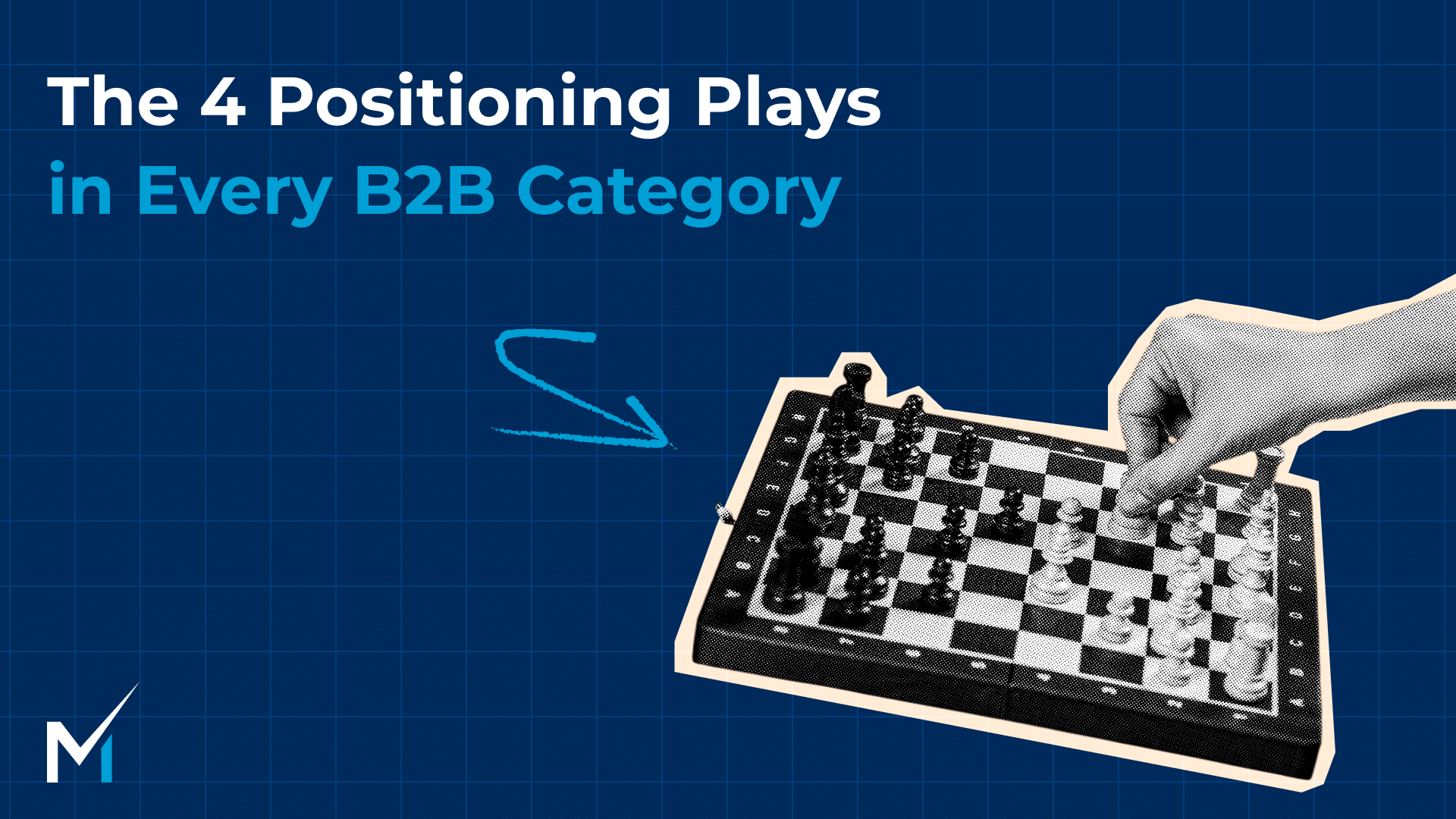
Four strategic postures underpin nearly every B2B ad you’ll see. The claims vary wildly by category. The plays don’t.
| Play | The argument | Typical proof | Who runs it |
|---|---|---|---|
| Outcome-led | We get you a result, faster | Percentages, timeframes, ROI figures | Category leaders and fast followers |
| Credibility-led | Serious buyers trust us | Analyst reports, enterprise logos, research | Enterprise vendors, high-ACV sellers |
| Offer-led | Here’s a deal too good to skip | The offer itself is the creative | Challengers buying attention |
| Methodology-led | Everyone else is doing it wrong | A named process or framework | Specialists and contrarians |
Most companies run one primary play with a secondary in support. When a competitor’s ads feel scattered, it’s usually because they haven’t picked one — which is its own kind of finding.
Play 1: Outcome-Led (Speed, ROI, Efficiency)
The argument: you’ll get a measurable result, and you’ll get it fast.
This is the default play in almost every category we’ve mapped, which is precisely the problem with it. In a July 2026 teardown of the custom AI development services category, the outcome-led claims stacked up like this: “From AI vision to reality in 4 weeks.” Engineers staffed “in 2 weeks.” “Up to 40% MTTR reduction.” “Board-ready results.” Different companies, same play, near-identical grammar.
In the sales-engagement category we mapped the same month, outcome-led looked like “Turn prospects into pipeline waaay faster” and “Work smarter. Close faster. Win more.” — with headcount displacement as the numeric flavor: “1 SELLER DOES THE WORK OF 10.”
What it looks like in an ad: a number, a unit of time, or both, in the headline.
When it works: when your number is genuinely better than everyone else’s and you can prove it, or when you’re the only one making a specific claim. Outcome-led is strongest in categories where buyers have a quantified pain and no obvious vendor.
How it fails: claim inflation. Once four competitors are all promising 40% improvements in four weeks, the numbers cancel out and buyers stop reading them as information. At that point you’re not differentiating, you’re paying LinkedIn’s CPM to participate in a shouting match. If your category looks like this, the fastest exit is one of the other three plays.
Play 2: Credibility-Led (Authority and Proof)
The argument: people like you, at companies you respect, already chose us.
Credibility-led ads sell safety. The buying committee’s real question isn’t “will this work” — it’s “will I get fired for choosing this.” Credibility play answers that one.
Real examples from category teardowns: one enterprise sales platform anchoring on analyst reports, a Siemens case study, and an ROI calculator. A development firm running research built on input from “480+ technology leaders.” Another leaning almost entirely on Microsoft, Odoo, and NetSuite partner badges. In the sales-engagement category, scale-as-proof was everywhere: “4+ Billion Emails,” “7M emails/month,” “Thousands of teams.”
What it looks like in an ad: logos, badges, analyst names, research counts, or a case study as the hero.
When it works: high-ACV, multi-stakeholder deals where procurement and legal are in the room. Also when you’re genuinely the safe choice and a scrappier challenger is undercutting you.
How it fails: two ways. Generic proof — “trusted by thousands” with no names — reads as noise. And credibility-led ads run without a specific outcome attached give the buyer no reason to move now. The strongest version pairs the logo with a number and a named human. The weakest version is a badge wall.
Play 3: Offer-Led (The Deal Is the Message)
The argument: the offer is so good it doesn’t need positioning.
This is the loudest play and the easiest to spot. A development firm running a “$150K in custom software development services” build grant with an application deadline. A channel-focused vendor running “Only 1 Day Left” on a “25-minute executive briefing.” Free-credit offers and no-friction trials — “Start for free” — across the sales tech category. Seasonal discounts, POC pricing, time-boxed pilots.
What it looks like in an ad: a dollar figure, a deadline, or the word “free” doing the heavy lifting in the headline.
When it works: breaking into a category where you’re unknown, or in categories where nobody else is running offers. Offer-led is genuinely underused in B2B services — in one of the categories we mapped, exactly one competitor out of six was running a real offer, and it was the ad you noticed first.
How it fails: it trains the market to wait for the discount, and it attracts trial users rather than buyers. It also decays fast — the second and third competitor to run an offer get much less lift than the first. Treat it as a wedge, not a position.
Play 4: Methodology-Led (Process as the Differentiator)
The argument: the way we do this is fundamentally different, and here’s what it’s called.
The rarest of the four, and usually the most defensible. In the AI development category, one firm ran “Prompting is not a methodology.” against a named delivery framework of their own — an explicitly contrarian shot at how the rest of the category works. Another ran “We deliver what others only pilot.” In the sales-engagement category, one platform built its entire position around governance — human-in-the-loop approvals and “no black boxes, total visibility” — while every competitor was competing on degrees of autonomy.
What it looks like in an ad: a named process, a stated principle, or a direct challenge to how the category operates.
When it works: in a saturated category where everyone’s outcome claims have cancelled out. Methodology-led reframes the question from “who’s fastest” to “who’s doing this correctly,” and that’s a question you get to define the answer to.
How it fails: it’s slower. Methodology requires explanation, which means it needs supporting content and a longer nurture. Run it as a single cold ad with no follow-up and you’ll get impressions and confusion. It also demands that the methodology be real — a made-up acronym gets found out on the first sales call.
This is the play we most often recommend to clients coming out of a whitespace analysis, because it’s the one the category has usually left open.
How Do You Tell Which Play a Competitor Is Running From a Single Ad?
Read the headline and ask what it’s asking you to believe. Four tells:
- A number or a timeframe in the headline → outcome-led
- A logo, badge, analyst name, or research count → credibility-led
- A price, a deadline, or “free” → offer-led
- A named process, or a claim about how the work should be done → methodology-led
Ads that hit none of the four are usually brand awareness plays, or a team that hasn’t decided. Ads hitting three at once are a committee compromise, and they underperform for exactly that reason.
Do this for every competitor’s five most recent ads, tally the plays, and you have a positioning map in under an hour.
What Happens When Everyone Runs the Same Play?
The claims stop functioning as information and the auction turns into a spending contest.
Here’s the pattern from two categories we mapped in July 2026:
| AI SDR / sales engagement | AI development services | |
|---|---|---|
| Competitors mapped | 7 | 6 |
| Dominant play | Outcome-led (automation, cost per SDR) | Outcome-led (speed, quantified ROI) |
| Second most common | Credibility-led (scale numbers, enterprise logos) | Credibility-led (partner badges, research) |
| Barely present | Methodology-led | Offer-led and methodology-led |
| The open position | Governance and control — human oversight of AI | Named vertical outcomes with delivery guarantees |
Two unrelated categories, same shape: everyone crowded into outcome-led, credibility-led as the runner-up, and methodology sitting almost empty. That’s not a coincidence — outcome-led is the easiest play to write and the safest to get approved internally, so categories drift into it by default.
Which is exactly why the open position is worth buying. You’re not being clever. You’re just being the only one there.
Which Positioning Play Should You Run?
Three filters, in this order:
- Which plays are crowded in your category? Cross those off. If four competitors are running outcome-led, your fifth set of percentages will not break through.
- Which of the remaining plays can you actually prove? Credibility-led with no logos is a bluff. Methodology-led with no real process is worse. This filter kills most candidates, and it should.
- Which one fits your deal size and cycle? Offer-led suits fast, low-consideration purchases. Methodology-led needs a longer nurture and supporting content. Credibility-led needs an ACV that justifies the enterprise apparatus.
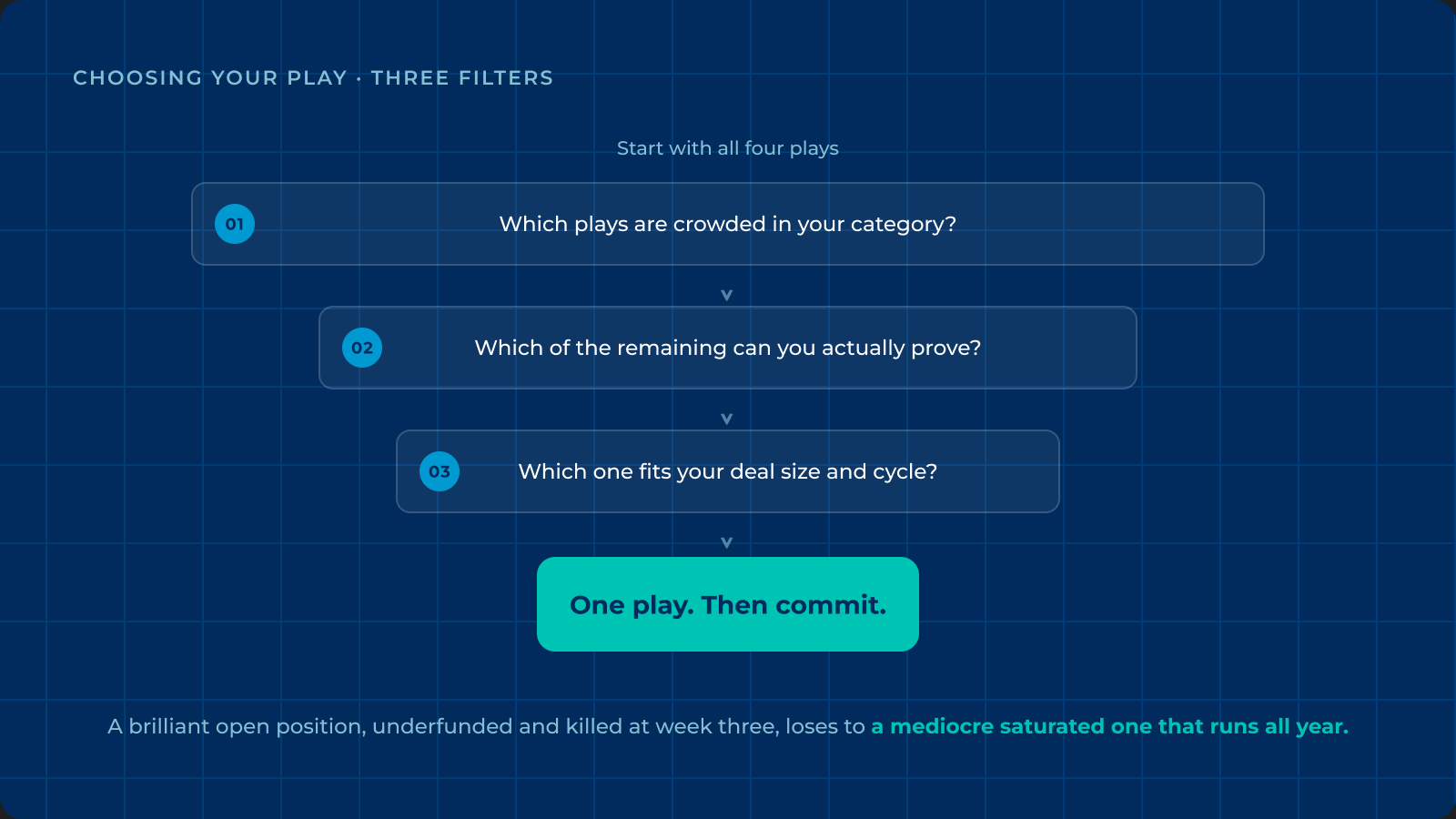
What’s left is usually one play, sometimes two. Then commit — run it long enough to register. B2B buyers need repeated exposure before a position lands, which is why the $3K/month budget floor and a 90-day judgment window matter as much as the positioning itself. A brilliant open position, underfunded and killed at week three, loses to a mediocre saturated one that runs all year.
Frequently Asked Questions
Can a company run more than one positioning play?
Yes, and most do — one primary and one supporting. Outcome-led headlines with credibility proof underneath is the most common combination in B2B. What doesn’t work is giving all four equal weight in a single ad, which reads as a committee compromise and converts like one.
Is methodology-led positioning only for agencies and consultancies?
No. Software companies run it whenever the differentiator is how the product works rather than what it outputs — governance models, human-in-the-loop approvals, and named workflows are all methodology plays. It suits any category where buyers are nervous about the approach, not just the result.
How do I know if my category is saturated on a play?
Pull five recent ads from each of your top six to eight competitors and tally which play each one runs. If more than half land in the same bucket, that play is saturated and you’re better off elsewhere.
What if my competitors aren’t running ads at all?
Then run the same mapping against their website copy, sales decks, and organic LinkedIn posts. Positioning shows up in all of those. An empty ad category also means whichever play you pick is uncontested, which is a rare luxury.
Does the right positioning play change over time?
Yes. Categories rotate — a play that’s open today gets crowded once two competitors move into it. That’s why the mapping is a quarterly exercise, not a one-time project.
Which play is the safest to start with?
There’s no universally safe answer, but the one you can prove hardest usually beats the one that’s theoretically most open. Whitespace you can’t back up with real evidence isn’t an opportunity — it’s a claim you’ll get caught on during the first sales conversation.
Map Yours
Take your six to eight closest competitors. Pull their five most recent ads each. Sort every ad into one of the four plays. Count.
The picture that comes back is usually lopsided, and the empty column is your opening. That’s the whole exercise — the positioning section of every whitespace report we produce, compressed into an afternoon you can run yourself. The raw material is free: every ad in the LinkedIn Ad Library, no login required, about fifteen minutes to pull.
Want the mapped version of your category, with the whitespace verdict attached? Book a discovery call.